Wednesday, January 17, 2007

Moher International Airport

The debate regarding emissions from air travel is hotting up, the latest development being the UK government imposition of a travel tax for all passengers. The phenomenal growth of low-cost carriers such as Ryanair and Easyjet has meant that such emissions are growing at an unprecedented pace, despite the introduction of more fuel-efficient aircraft. There are moves afoot for the EU to introduce similar measures on a Europe-wide basis.

In Ireland, the obligatory Shannon stopover for many transatlantic flights has, for many years, added to aviation pollution, as each take-off consumes a very high proportion of an aircraft’s fuel-load. However, we’re unlikely to see any voluntary change in the stopover regime as the economic benefits to the Mid-West Region far outweigh global environmental concerns, if any, for the Government.

Before the imminent publication of the National Development Plan, perhaps an alternative solution might achieve an acceptable compromise between economic and environmental considerations and could still be provided for in the plan.

The Proposal

Move Shannon Airport to the Cliffs of Moher and, using a catapult system similar to that employed on aircraft carriers, launch aircraft off the cliff top and out over the Atlantic. This should significantly reduce the amount of fuel burned in take-off and thus reduce emissions. The new visitor centre would make a fine terminal building, while the car park is already big enough.
If this all seems a little far fetched, please be assured that it has received as much detailed consideration as many other major Government initiatives e.g. decentralisation.

The difference is that I’m willing to publish my detailed plan (click on image to enlarge) for this innovative proposal, unlike the Government who have refused to show us the back of their envelopes with the detail of Decentralisation, Dublin Metro system etc..

Tuesday, January 16, 2007

Limerick limericks

This week Pat Kenny is running a “Limerick” competition, the first line must be “There was a red army from Munster”. The prize is two tickets for the last match to be played in the current Thomond Park ground, Munster v Leicester in their final pool stage Heineken Cup match.

Tickets will be as hard to find as hen's teeth and will sell on ebay for a couple of hundred euros apiece, so I've submitted the following entry. It's a touching tribute to Alan Quinlan’s recent 6-week suspension for stamping in the game against Cardiff.

There was a red army from Munster
Their team the proverbial dumpster
With tackle and stamp
Opposition they tramp
And suspensions just give them the hump, sir.

I’m not holding my breath for a winning outcome.

Sunday, January 14, 2007

Micheal "Gekko" O'Leary

Michael O’Leary is Chief Executive of Ryanair and the darling of the media.

He earned salary and bonus of €779k in the year ended 31st March 2006 and treats the company like his own plaything, even though he actually owns only 4.53% of the equity. No other board director holds even 1%.

O’Leary is an endless source of quotable quotes and publicity stunts, perhaps most notably driving a tank up to Luton Airport, the main base of Easyjet, his main rival in the low-cost airspace.

He is routinely lauded by the media as Ireland’s most capable and successful businessman - ever. However, to me he seems more like the Gordon Gekko of Irish business, a “greed is good” prophet in real life. His belligerent attitude is clearly more than just a publicity stunt, there’s been ample evidence from a myriad of court cases and employment tribunal hearings that he’s as obnoxious within the company as he is without.

The case that he’s the most capable and successful Irish businessman ever, or even currently, is certainly open to question. Quite apart from the likes of Tony O’Reilly, Michael Smurfit or Denis Brosnan, who developed their businesses and made their millions in far less benign economic times, there are several Chief Executives of Irish companies, who don’t get anything like the profile or credit accorded to O’Leary.

In early/mid 2003, I invested in a portfolio of shares, many of them Irish-owned and managed. The acid test for any investor is how the shares perform, so here’s a little comparison I can make myself.

The table below shows the relative growth in the share prices in the intervening period of almost 4 years. Of the 8 shares listed, Ryanair’s growth has been the least spectacular - by a significant margin. Indeed, in the intervening period, the Ryanair share price was often below the purchase price - it’s main gains have been in the past year. How many people can name the Chief Executives of the other companies, who have all outperformed the high profile O’Leary?

AIB: +106%
CRH : +165%
DCC: +127%
Grafton: +221%
IAWS: +156%
Kenmare: +319%
Kingspan: +1079%
Ryanair: +76%

Saturday, January 13, 2007

Jonah

The 70ft trawler Pere Charles, fishing out of Dunmore East, was lost with all five hands during the past week’s violent storms.

One of the drowned crewmen was Pat Coady, who came from a family with a long tradition as fishermen. His father Stephen drowned in January 2006 and grandfather Paddy drowned in 1995.

That’s what you'd have to call a Jonah. Given the superstition that prevails among seafarers, the biggest surprise is that the rest of the crew agreed to sail with him.

How's your battery?

The BBC recently conducted an experiment where one of their staff agreed to live without electricity for a week. That meant no appliances of any kind - cooker, phone, fridge, light, radio, tv etc.. I only heard a small extract of his thoughts on the experiment, but he got me thinking.

He described cooking dinner and checking if something was cooked, with his candle dripping wax into the pot. His experience of preparing and cooking food in semi-darkness was extremely difficult, and he wondered if that was the reason that, in earlier times, people used eat their main meal in the middle of the day.
He described the difficulty of trying to read by candlelight - he had to give up because of the eyestrain involved.

He speculated that the pace of life for our ancestors must have shown very significant seasonal variations - very different in the short winter days to the almost endless days of summer.

Nowadays, we have 24-hour everything - radio, tv, internet, take-away pizza. We are in constant light - even at night in cities the street lights and reflected light off the sky (clouds?) means that city-dwellers rarely, if ever, experience anything like total darkness.

Our lifestyles have adapted to these changed circumstances, we are instantly contactable by phone, email, text etc.. Cars and planes have transformed the way we commute, work and play, though each comes with it’s own brand of stress. We are bombarded by media of all types, far too much choice and far too much dross.

All this change has happened in the space of not much more than 100 years (remember that in Ireland, rural electrification only happened in the 1940s & ‘50s!).

So here’s the thought: a species will adapt naturally to accommodate/exploit changed circumstances in a slow process known as evolution. This would normally take several thousand years - or hundreds at least.

We’ve had to do it all in decades, and it’s still ongoing - faster than ever. Is it any wonder that people fell stressed by the pace of life and the demands of modern society?

We’ve turned ourselves into battery hens!

Fly KennyAir

In an interview published in last Monday’s Irish Independent, Fine Gael leader Enda Kenny proposed an investigation of the feasibility of providing a second airport for Dublin. Baldonnel, and Weston were two possible locations, though he didn’t rule out a greenfield site.

Ryanair’s Michael O’Leary dismissed the idea as rubbish: "Parties in opposition tend to come up with stupid ideas but a second airport for Dublin would be pretty much up there on the scale of stupid ideas with the Dublin Airport Metro – something that will never be used and will never work".

Which raises the question - where might Michael be coming from?

After all, Ryanair flies to secondary and tertiary airports on the continent - some located long distances from their supposed destination e.g. Paris-Beauvais, Brussels-Charleroi, Barcelona-Gerona etc..

Such airports offer benefits to both airlines and passengers alike.

Airlines can expect significantly better deals re landing charges, while low usage levels facilitate faster turnaround of planes, with little risk of aircraft having to queue for landing or take-off.

Passengers may also benefit in a number of ways. Generally, road access will be easier, even if a bit further, and parking will probably be cheaper. Because the airports themselves are less busy, passengers can be processed more smoothly and with less stress than in a busy, overcrowded terminal like Dublin Airport. Baggage reclaim is also easier if only one plane is being processed at any given time.

No low cost airline is going to compete head-to-head into and out of Dublin Airport with Ryanair. Easyjet and GO tried it but were quickly forced off their chosen routes by Ryanair’s predatory tactics - replicating those routes and using loss-making pricing to attack competitors whose pockets were not as deep.

However, Easyjet or BMIbaby flying into Baldonnel or Weston might pose a bigger challenge for Ryanair. The airport itself is now the most stressful part of flying and people might well be willing to pay a few euros more for the ability to use an airport that was easier to get to and get through.

Ryanair might be forced to offer flights from that second airport in an attempt to force the competition out. Using two airports for the same city would duplicate many overheads, result in the sub-optimal use of aircraft and risk confusion among passengers as to which airport they were flying to/from.

So Michael might really think a second airport is a great idea, unless you’re Ryanair.

Footnote: An edited version published as a letter in the Irish Independent

Thursday, January 11, 2007

The Bull O'Donoghue

In an article on negative politics/campaigning in the Irish Times on Saturday 6th January, political correspondent Mark Hennessy recalled the last “Rainbow Coalition” period in office (1994-97) when Nora Owen (FG) was Minister for Justice and John O’Donoghue was Fianna Fail front-bench spokesman on Justice. Hennessy described O’Donoghue’s approach thus: "frequently bordered on the vicious"; and "certainly targeted, personal, sustained and ultimately, probably successful".

O’Donoghue, currently Minister for Arts, Sport & Tourism and a political pitbull, had a letter published in the Irish Times (10th Jan) vehemently denying this description and listing his political achievements in the Justice area while in opposition.
This prompted me to send the following letter, which I’m delighted to see that they’ve published today (Friday 12th January).

Madam - Anyone who recalls the performance of John O’Donoghue as opposition Justice spokeman will have a mental picture of a red-faced political boot-boy, laying into Minister for Justice Nora Owen.

He deemed her personally responsible for every crime committed in the country and attacked her at every opportunity. Mark Hennessy’s description of O’Donoghue’s approach was quite accurate.

In hindsight, Mr O’Donoghue’s own rhetoric on “zero tolerance” proved to be complete waffle when he became Justice Minister, while any Fianna Fail minister taking personal responsibility for bad news remains an alien concept, in stark contrast to their willingness to claim credit for the success of the economy. Yours etc.

Wednesday, January 10, 2007

Blue Circle Luas Line

The transport plans for Dublin City include an extension of the Luas Green Line to O’Connell St, primarily to intersect with the Luas Red Line, facilitating the transfer of passengers from one line to the other.

In addition, the proposed Metro will run from St Stephen’s Green, via O’Connell St, out to the airport.

All Dublin’s major transport systems and routes - bus, DART, Luas, train, metro - both current and planned, radially converge in An Lar, the city centre. This is a relatively small area, a radius of a couple of hundred metres around O’Connell St.

One result of this is extraordinary traffic congestion in the city centre which, in turn, causes serious delay to the bus service, the major public transport service for the city.

Another consequence is that getting across the city in any circular direction is almost impossible using public transport.

An objective of planning and transport strategies should be to increase the size of that central city footprint to a wider “inner city“ area, reducing the concentration of traffic at the absolute centre and improving commutability across and around that inner city area.

The extension of the Green Line to the top of O’Connell St creates the risk that all south-bound trams at rush hour will be full by the time they arrive at the current Stephen’s Green Luas terminus.

Here’s an alternative proposal which is either brilliant or daft.

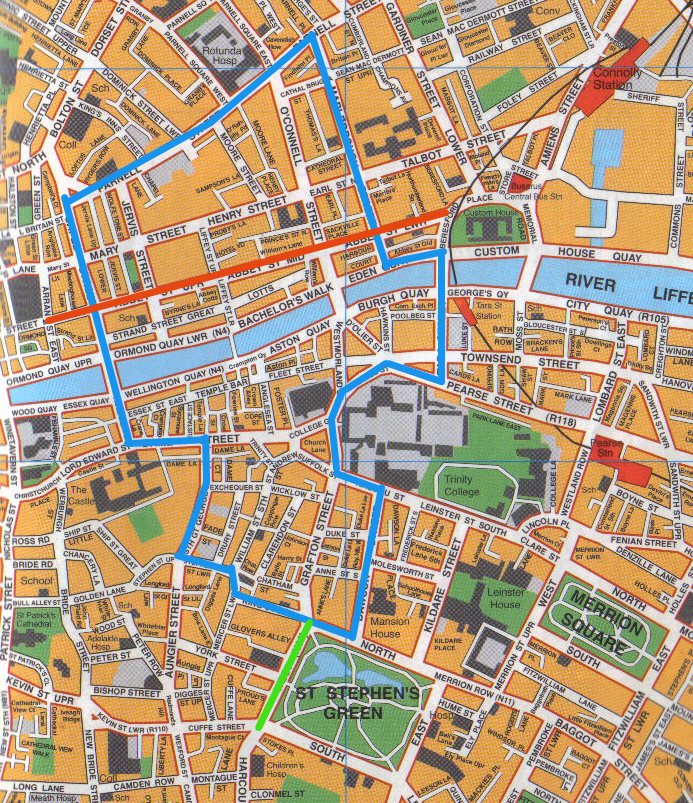
To achieve the desired Luas interconnection (and support other public transport interconnectivity - bus & dart), why not create a new circular line which serves the wider city centre - a new Luas Blue Circle Line. The attached map (click on map to enlarge) illustrates one possible route (see street details below).

The suggested way of running this is a single line, one-way (anti-clockwise would best fit with existing traffic flows), continuous loop service - which reduces the encroachment into existing road space, cost and time/disruption and allows for increased frequency with a smaller number of trams e.g. 4 trams could probably guarantee a service every 5 minutes. The trade-off is that it constrains the overall length of the line (illustrated example is approx. 3 miles long) - if it’s only going one-way, you need to keep the round-journey time to an acceptable limit - e.g. max 20 mins.

The main benefits of such a line would be to facilitate
(a) cross-city centre and inner city commuting, thereby reducing car traffic in the central area
(b) connecting with the Green Luas at Stephen's Green, crossing the Red Luas line in two places, connecting with DART at Tara St and numerous bus termini and routes.
(c) running a limited number of Green Line trams on this inner loop line at peak times, if necessary
(d) development of somewhat run-down areas of the city centre e.g. Capel St, Parnell St., Aungier St, etc expanding the footprint of the “city centre”
(e) increased demand arising from numbers of apartment dwellers in inner city locations.
(f) moving some suburban bus termini a little further out from the O’Connell St/Quays area - reducing their journey/turnaround times and easing traffic in the most congested central city area.
(g) provision of inner city multi-storey parking slightly removed from the city centre itself

Suggested Route
Blue Circle LineTerminus South King St - across St Stephens Green Nth, down Dawson St, around College Green, Tara St (connecting with DART)
Across bridge, Eden Quay, Marlborough St, Parnell St, Capel St
Across bridge, Parliament St., Dame St, South Great Georges St, Stephen St Lr, Mercer St Lr, back to South King St.

At junction of Stephens Green/Grafton St/South King St a connecting track between Blue and Green Luas lines to allow trams to move from one line to the other as required.

Tuesday, January 09, 2007

Can Gerry Robinson fix the Health service?

Although last night was only the first of three episodes, I suspect that BBC2’s “Can Gerry Robinson fix the NHS?” should be made compulsory viewing for all the parties involved in delivering health services in the Republic.

Not only do the positions of the various vested interest groups seem familiar, but it’s quite likely that any solutions developed could be highly relevant to Irish hospitals.

All parties involved in the delivery of medical services - consultants, surgeons, anaesthetists, nurses, administrators - think that they’re working both hard and effectively, that the problems with waiting lists arise because of failings in someone else’s domain.

Similarly, all interest groups seem to have some feasible solutions to offer, but no mechanism to have these moderated within the wider hospital medical community. There is no effective mechanism for agreeing and implementing change.

It was clear that the hospital administrators have responsibility without any real authority. This results in a reluctance to push for change because of the risk that a public rebuff by consultants etc will undermine whatever limited authority the administrator may have with the wider hospital population. So they are forced to pussyfoot about - avoiding confrontation by avoiding proposing anything approaching radical change.

The presence of the cameras means that Robinson’s task should be a little easier; the Hawthorne effect will probably cause people to co-operate somewhat more in achieving change than would normally be the case.

However, a trailer for the next episode showed a couple of consultants chatting about the problems. One was querying the capability of the administrators, as in “why should someone with a couple of O Levels be directing the activities of professionals who each have several university-level qualifications?”.

One to follow.

Sunday, January 07, 2007

Justice v. The Law

The posthumously published thoughts of Mr Justice Sean O’Leary, former judge of the High Court, make interesting reading for the layman, particularly his criticism of the Supreme Court in the Mr A case.

An abiding memory of that case was the procession of eminent Senior Counsels who populated the broadcast media and, with varying levels of exasperation, tried to explain that Joe Public was confusing justice and the law. In the minds of the lawyers, these are clearly two very different concepts.

On the one hand, Joe Public is constantly confused by the ability of judges of all courts to dismiss charges on the slightest of legal technicalities, simultaneously discharging defendants who have clearly broken the law and enriching lawyers who have found some minor loophole. The current system encourages defendants to go all the way in the legal process in the hope that some minor defect may save them. This clogs up the courts and vastly increases the associated costs of running the legal system.

On the other hand, the Supreme Court, in arriving at their decision, was perceived by Joe Public as having delivered justice, even if the lawyers thought it was not necessarily in accordance with the law.

Mr Justice O’Leary (and the Irish Times editorial of 4th January) absolves the Minister for Justice and the Attorney General of any responsibility for the difficulties that arose when the courts struck down the constitutionality of the existing statutory rape legislation. Surely it is the responsibility of Government to create the law and the courts to interpret it? The potential difficulties with the then existing legislation and the likelihood of a constitutional challenge had been highlighted in legal journals, long before the actual case was taken.

So how could Mr Justice O’Leary condemn the Supreme Courts judges for their decision in the Mr A case, on the basis that no offence in law existed and therefore the plaintiff should have been successful and released from prison, while at the same time absolving the chief law officers of the Government from any responsibility to have corrected the defect in the existing law? Surely these are contradictory positions?

And finally, if the function of the courts is to adjudicate on the law, rather than concern itself with the delivery of justice, why are judges still accorded the address of “Mr Justice” etc..? From now on let’s just make it plain “Judge”.

Parking Tax

There was a time that you found parking meters in or adjacent to busy town centres. Now, however, they are extending inexorably into the suburbs.

Dun Laoghaire is a classic example, where metered parking is in operation on all streets and it has extended to the main and side streets of its village suburbs of Sandycove, Glasthule, Monkstown etc.. The metered area is constantly extending and now the meters have appeared on Station Road and Marlborough Road, the main parking streets for commuters using Glenageary DART station. The all-day charge of €5 means that commuters will have to pay up to €25 extra per week.

Their presence means that other suburban streets near the station will now become home to the cars of daily commuters, while some commuters will simply decide that it’s as cheap to park in town as it is to pay parking and DART fares. Residents in those newly colonised streets will be greatly inconvenienced by the number of parked cars. They will be offered a solution by Owen Keegan - install parking meters on your road and the problem will move again.

Now Owen Keegan, county manager for Dun Laoghaire-Rathdown has announced the immediate introduction of clampers to the borough, supposedly because of the high incidence of non-payment of parking fines.

In Keegan’s previous role as traffic tzar for Dublin, he introduced clamping to the capital. At the time, we were assured that clamping would only be used on cars that were illegally parked and causing an obstruction to traffic. We all know what a blatant lie that soon turned out to be.

Parking meters and clamping are merely taxation by another name. This is a purely opportunistic revenue raising operation, as no new or improved parking facilities have been introduced by the county council.

Footnote: a variant on this theme published as a letter in the Irish Examiner (13th Jan)

Curing A&E?

The HSE task force set up to address the problems with A&E will propose a target for all patients to be admitted to a hospital bed or discharged within six hours of arriving in an emergency department by the end of the year. They will set an interim 12-hour target – from time of a decision being made by medics to admission – to be achieved within the next three months.

Unsurprisingly, Liam Doran of the Irish Nurses Organisation claims such targets are unrealistic and impossible without additional resources.

I’m only familiar with the activities in one hospital, St Vincent’s in Dublin. If a patient is not discharged when the consultants do their rounds on a Friday morning, he/she will not be discharged over the weekend.

I’ve long suspected that this approach may be particularly applied to those in-patients who have private health insurance, typically VHI or BUPA. Such weekend stays allow the hospital to bill the insurers and generate incremental revenue for the hospital.

However, the weekend is also the busiest time in A&E. Surely doctors should be actively discharging appropriate patients on Saturday and Sunday as well? The unavailability of beds in the hospital means that patients who need to be admitted and kept overnight have to be housed within the A&E unit itself - something it was never designed for. This leads to the chronic overcrowding, lack of privacy etc which have generated all the negative, but deserved, publicity.

In addition, a policy of temporarily discharging suitable, non-critical patients on Friday, to return on Monday, might free up a substantial number of beds, and also be welcomed by the “paroled patients” who get to go home for the weekend?

There was life before Microsoft

Watching the movie Apollo 13 on TV last night, I was struck by the need of the astronauts (in 1970) to manually transfer data from one computer to another. It reminded me of claims that there is more computing power in the microchip of a digital watch than in the computers used on these early space missions.

Then I realised that there was a possible explanation for this, and that the early computers may well have been all the more effective for it.

They didn’t have to run Windows, the Microsoft operating system that takes up most of the memory on your ordinary computer. They didn’t have to run Microsoft programmes, which consume any memory left after Windows has been loaded. They didn’t have to reboot on a regular basis because of bugs in their Microsoft system/programmes.

The pre-Microsoft computer had straightforward programmes which performed clear functions which were both required and understood by their users. Contrast that with programmes like Powerpoint or Excel. Most users need about 5%-10% of the functionality provided. Even if they knew the rest existed, which they generally don’t, they still wouldn’t want it or ever use it.

So if you could eliminate all the bits of Windows and programmes that you don’t actually use or want, you could probably work happily away with your old Commodore 64 or Sinclair ZX81.

It’s still up in the attic - they haven’t gone away you know!

Nominating Deasy for top media award

Published in today's Sunday Independent under the heading "Deasy set to receive dubious accolade"

Sir - In the same week that John Drennan named Mayo TD Jerry Cowley as the very worthy winner of '2006 Political Gobshite of the year', (SI, 31/12/06) Fine Gael's John Deasy has, barring a miracle, guaranteed himself the same accolade for 2007. Yours etc.

Saturday, January 06, 2007

Taking the piss out of Oscar

On a current radio ad, musician Paddy Cole quotes Oscar Wilde “I have the simplest of tastes, I only want the best", before inviting listeners to visit the showroom of Elegant John (you've guessed it) purveyors of toilets and other bathroom fittings.

What a travesty - poor Oscar must be spinning in his grave in Père Lachaise cemetery to find himself (ab)used to help sell lavatories.

Friday, January 05, 2007

More Fine Gael eejits

Following his appearance on RTE's Morning Ireland today, I sent the following email to Damien English. (damien.english@finegael.ie , denglish@oireachtas.ie). It seems he’s away skiing in Andorra, such a pity that he hadn’t his mobile phone switched off when Sam Smyth of the Independent came calling. On the lunchtime news, Mark Hennessy, political correspondent of the Irish Times, described English’s performance on Morning Ireland as “naïve, bordering on stupid“. Personally, I detected no border.

email:
Young talent in Fine Gael my arse!
As a lifelong Fine Gael voter, if you or John Deasy ever emerge as senior members of the party I'm switching to Labour.


What a pair of f***ing eejits! The big media issue is now the leadership of Enda Kenny, they must be shitting themselves laughing over in FF HQ.

Frankly, I hope the pair of you lose your seats. You're no asset to any party and your pathetic performance on Morning Ireland will have given the electorate no confidence in the capability of FG's younger TDs.

I thought Deasy had nailed "gobshite of the year 2007" but he's obviously got strong competition. Sadly, it's within FG!
Yours etc.

Wednesday, January 03, 2007

Past his best

An eye-catching short letter by another writer in today's Examiner, under their equally clever heading "Past his best".

Dear Sir,

Your historian columnist Diarmaid Ferriter advocates a Labour /Fine Gael merger (Irish Examiner, December 28).

Stick to the past, Diarmaid.

Yours etc PJ McElhone

FG's Gobshite of the Year - already!

John Deasy, Fine Gael TD for Waterford, has today announced that he’ll be challenging Enda Kenny for leadership of the party should Fine Gael fail to be in Government after the next election.

At a time when the opinion polls have given Fianna Fail a boost and the media are openly sceptical about Enda Kenny’s political appeal, Fine Gael need the latest Deasy intervention like a hole in the head.

In 2004 Deasy was sacked as Fine Gael’s front-bench spokesman for Justice, when he flagrantly and childishly broke the law by smoking in the Dail bar after the smoking ban had been introduced. He continued to do so despite several requests from Dail staff to move outside if he wished to smoke.

The addition last year of a 3rd candidate to the Fine Gael ticket for the Waterford constituency for the upcoming election was fiercely resisted and resented by Deasy and, added to his earlier sacking, means that relations with party leadership have probably never been worse.

His old man, Austin Deasy, was a former Fine Gael TD (1977-2002) and Minister for Agriculture (82-87) who also fell out with the party leadership (sparking leadership challenges to both Alan Dukes and John Bruton) and spent his last years sulking on the backbenches and sniping at his leader.

His son is clearly a chip (on the shoulder) off the old block.

I’ve emailed him the following appreciation. (to john.deasy@finegael.ie)

John,
Well done, a strong early entry for political gobshite of the year.
You already demonstrated what a childish tosser you are with that smoking lark. Now you've confirmed that you shouldn't be let near the Dail, never mind leadership of Fine Gael.
Your old man had a chip on his shoulder, it's a pity it hasn't skipped a generation.
If the leadership should happen to move to the next generation, it certainly won't be to a prat like you! Yours etc.

Tuesday, January 02, 2007

Traveller Ping Pong 2

Ping (Incoming 1st January)

Peter - I'm a columnist, I don't do impartiality. The tone I used to make enquiries of pavee point was the same as I would use to any lobby group or politician or spokesperson dodging a legitimate question. But I understand that anything but kid gloves for travellers constitutes unforgiveable discrimination. Again, personal responsibility doesn't arise - if you don't like 'the tone' of the question, but especially the question itself,you have automatically been offended and are entitled to demand legal redress. Brenda P

Pong (Outgoing 2nd January)

Brenda,
You certainly don’t do impartiality, that much has become abundantly clear. Nor perhaps do you do enough research before writing incendiary press articles - “I don't believe for a second that there are 1000 traveller families without accommodation - there are only around 1000 traveller families in the whole country”

You seem to believe that you were hard done by in your dealings with Pavee Point and deserving of sympathy on the topic. Have you any mirrors in your house ? Try reading aloud, to yourself, your venomous article and emails, in a tone of voice that is consistent with the content. Look at yourself in the mirror as you do it. It’s ugly. It might just demonstrate why it would cause more than usual offence. It’s the difference between begging and aggressive begging - the latter is a form of mugging without the actual physical contact, but with the implicit threat of it. You don’t seem to be able to see that.

You deride the bleeding-heart liberals who seek to defend/explain travellers and attribute to them a total blindness to the problems caused by the behaviour of a minority, but too many, of the estimated 25,000 travellers (6.5k families) in the country.

The other side of that “bleeding-heart liberal” picture you paint would be the “red-neck hillbilly” who believes that the only good traveller is the one in someone else’s county, or country (or dead?). Again a minority, but too many.

You cannot believe that the belligerence of your approach could convince the broader traveller community, or their liberal fellow-travellers, that you empathise in any way with them or have any real interest in their issues - “the causes of crime“. Your approach will appeal to the red-neck hillbilly minority, but it will probably alienate the silent majority of the population, who would undoubtedly like to see an end to traveller nomadism but recognise that much more needs to be done to help that community.

What is needed is reasoned, open and robust debate where all parties can acknowledge their shortcomings and set out their issues, with proposed solutions attached - both short and long-term. This would require mutual respect and the avoidance of branding an entire community with the transgressions of a minority of their members. (Or expecting Pavee Point to be responsible for the entire traveller community. No-one expects someone to stand up and take responsibility for Moyross.)

I had hoped, foolish as it now seems, that you might be persuaded to moderate your tone, in the hope that you might actually be someone who would help push forward that honest debate and get the traveller issue much higher up the political agenda.

I don’t propose to waste any more of your time.
Regards, etc