The French invention of “Paris Plage” 200 kilometres from the sea has prompted me to propose “Dun Laoghaire Plage" as a possible local solution.
The Proposal
This involves the construction of a new breakwater linking the baths to the back of the East Pier - possibly at the location of the “geographical pointer” there. The breakwater would require some type of sluice gate and/or pumping mechanism to both maintain a desired water level inside the breakwater and the ability to refresh the water periodically to maintain water quality.
The newly enclosed area would now be filled with a beach, made of imported sand, and a relatively shallow lagoon. The enclosed nature of the construction means that the area of beach available to the public will be constant as it is not subject to tidal fluctuations. Also the depth and expanse of enclosed water will also be constant. This should provide a greater degree of safety for users.
The orientation and layout of the artificial beach are important considerations: that section of sea-front backing onto Queens Road is effectively north-facing and thus the least attractive from a sun-bathing perspective. (This problem also impacts on the amenity attractiveness of the baths) The artificial beach backing onto the new breakwater will be south-facing and get the most exposure to direct sun, while the section backing onto the East Pier is east-facing and will get good morning sun, but no evening sun.
The proposed Plage should provide at least twice the maximum area of beach available at Sandycove, without the periodic tidal incursions. The breakwater could be constructed so as to facilitate sea swimming from the seaward side of the construction.
It should be relatively straightforward to create café, shop & toilet facilities to the rear of the East Pier (there are currently fenced off shelters there), perhaps augmented by a Liffey-style boardwalk. More sophisticated dining and leisure facilities could be provided in the old baths premises, the objective being to provide an integrated leisure complex which can accommodate all the family, and families of varying means.
The addition of a beach and a safe swimming/paddling area would significantly increase the attractiveness of the overall amenity. The use/function of the old swimming pools and premises would need to be reviewed in light of the expanded adjoining swimming facility.
Ongoing Maintenance
Maintenance of the area - both in terms of cleanliness, facilities and ambience (e.g. no public drinking, loud music etc.) will be critical to the success of the complex. The Council might consider imposing a modest entry charge which would pay for cleaning, security & maintenance staff, while hopefully discouraging undesirable elements. This income would also be supplemented from rents from concession holders within the complex.
Paris Plage only operates for the summer months and there’s no reason why DLRCoCo might not consider operating Dun Laoghaire Plage on, say a six-monthly basis - April to September at least in the initial years. Allowing the area to “flood” while closed would ensure that it didn’t become an eyesore during that period.
Demand for the beach element will be largely driven by weather considerations and winter storms might well make it difficult, if not impossible, to maintain the artificial beach on a year-round basis. In addition, it would be desirable to provide some form of covered shelter to cater for our sometimes unpredictable summer weather.
Role of the Harbour Company?
Clearly this particular “Plage” proposal involves use of a section of the East Pier so could not progress without the approval and involvement of the Harbour Company.
Dun Laoghaire Harbour is the major landmark for the town and probably it’s most used public amenity. People come from a wide catchment area “to walk the pier”. The amenities - café, shops etc provided for the Plage could also be used by pier walkers, thus materially enhancing that amenity.
The Harbour Police could be used to provide security on the Plage, thus maintaining the high standard of the facility.
If the Plage was to be developed in conjunction with the Carlisle Pier proposals, it might well help to deflect some of the public objections to that particular development. Particularly if part-funding of the Plage development and/or its ongoing maintenance were linked to the revenue streams from the Carlisle Pier development.
Benefits to Dun Laoghaire
The proximity of the proposed Plage to the town centre should be beneficial to trade there.
Existing beaches at Sandycove and Seapoint are too far removed from the commercial centre, and the former is too small, to be of material benefit. The numbers using Sandycove on sunny days would suggest a significant demand for such a facility, particularly for young families.
The provision of this amenity should revive some of the tourist trade in the town. There was a time when there were several small hotels on the seafront, though current property values suggest that a return to that situation is highly unlikely.
Costs
I am not is a position to cost this proposal, but the breakwater and artificial beach elements seem like a “modest proposal”.
The actual construction cost should not be too great and the ongoing maintenance would probably pose the biggest financial challenge to the local council. Partnering with the Harbour Company would obviously make financial sense if that was feasible.
The renovation/conversion of the old baths complex is likely to require a greater investment and might be left to a "phase 2" period of the overall development until the "Plage" has proven it's drawing power.
Friday, August 25, 2006


The Empire Strikes Back
Well at least I'm getting their attention, this is published in today's Irish Times. Mind you, the employment of consultants is the classic way for politicians to deal with any hot potato. You could wallpaper Government Buildings with the various unimplemented consultants reports commissioned over the past couple of years.
That said, I like the tone of Owen Keegan's apparent commitment and he is a man who comes with a reputation for getting things done - even if he became a hate figure for Dublin motorists. Time will tell. I wonder if this would be a good time to pitch "Dun Laoghaire Plage" to him? Maybe not.
Madam, - Peter Molloy (August 17th ) is mistaken in his view that "last year's protests have scared local politicians and the county council is unlikely to propose any new initiative for fear of another backlash. Consequently we could be faced with years if not decades of inaction on this bricked up and derelict eyesore on the seafront ."
On the contrary, we will shortly be engaging consultants to prepare proposals for a major environmental/amenity improvement scheme covering the area between the East Pier and Sandycove. The overall objective will be to create a world class amenity for our own residents and visitors to enjoy. We envisage a facility in keeping with the world class setting and incorporating the S2S - Sandycove to Sutton Promenade and Cycleway project. The development will also be consistent with the recommendations of the council's baths subcommittee. Any new proposals will of course be put out to public consultation.
I do not wish to underestimate the likely difficulties in financing whatever project emerges or to discourage funding from outside agencies.
However, it remains my view that the true measure of the value of a project to the council is the extent to which the council is prepared to invest its own money to ensure its completion! - Yours, etc,
OWEN P KEEGAN, County Manager, Dún Laoghaire-Rathdown County Council, Dún Laoghaire, Co Dublin.
That said, I like the tone of Owen Keegan's apparent commitment and he is a man who comes with a reputation for getting things done - even if he became a hate figure for Dublin motorists. Time will tell. I wonder if this would be a good time to pitch "Dun Laoghaire Plage" to him? Maybe not.
Madam, - Peter Molloy (August 17th ) is mistaken in his view that "last year's protests have scared local politicians and the county council is unlikely to propose any new initiative for fear of another backlash. Consequently we could be faced with years if not decades of inaction on this bricked up and derelict eyesore on the seafront ."
On the contrary, we will shortly be engaging consultants to prepare proposals for a major environmental/amenity improvement scheme covering the area between the East Pier and Sandycove. The overall objective will be to create a world class amenity for our own residents and visitors to enjoy. We envisage a facility in keeping with the world class setting and incorporating the S2S - Sandycove to Sutton Promenade and Cycleway project. The development will also be consistent with the recommendations of the council's baths subcommittee. Any new proposals will of course be put out to public consultation.
I do not wish to underestimate the likely difficulties in financing whatever project emerges or to discourage funding from outside agencies.
However, it remains my view that the true measure of the value of a project to the council is the extent to which the council is prepared to invest its own money to ensure its completion! - Yours, etc,
OWEN P KEEGAN, County Manager, Dún Laoghaire-Rathdown County Council, Dún Laoghaire, Co Dublin.
Thursday, August 24, 2006
A shot across my baths!
The following letter is published in today’s Irish Times. This is what you'd call a robust rebuttal of my last published contribution on Dun Laoghaire Baths and a fine example of the old adage that attack is the best means of defence.
I defend Mr Tighe’s right to indulge in sweeping generalisation (while I question the veracity) and his use of very robust language, mainly because I indulge in such things myself. Bear in mind that the SWP organisers claim that over 3,000 participated in their protest march on June 12th, so 99% of that would be 2,970+. I suspect that we're seeing yet another incidence of the dreaded "Bewley's Syndrome".
In fact I particularly like the pithy construction of his sentence “This is a stunningly ignorant conclusion and a complete fabrication” and will be looking for an opportunity to employ it myself on some other topic in the future.
Madam, - Peter Molloy (August 17th) says it is a sad fact that most of the middle-class people who protested against the planned development for the site of DúLaoghaire Baths had probably never used the baths when they were open.
Probably indeed! As one of the aforementioned middle-class from Dún Laoghaire-Rathdown with wide contacts and ties with my community I can guarantee Mr Molloy that 99 per cent of those present were regular and enthusiastic patrons of the baths. One would have to be living in total seclusion not to know that in the local area.
This is a stunningly ignorant conclusion and a complete fabrication.
The fact is that we all used the baths, both winter and summer, and call for it to be reopened once again as Dublin's, and possibly Europe's, only outdoor public seaweed baths.
(In fact, many of the older protesters first learned to swim there under the renowened teacher Mr Gillespie.)
The revenue from tourism alone would more than help assuage the financial fantasies of the council, who, as witnessed by the protests, have acted in a thoroughly selfish and anti-democratic fashion.
How many times would those same councillors use the baths? As many times as Mr Molloy I suspect - zero! - Yours, etc,
DYLAN TIGHE, Aubrey Park, Shankill, Co Dublin.
I defend Mr Tighe’s right to indulge in sweeping generalisation (while I question the veracity) and his use of very robust language, mainly because I indulge in such things myself. Bear in mind that the SWP organisers claim that over 3,000 participated in their protest march on June 12th, so 99% of that would be 2,970+. I suspect that we're seeing yet another incidence of the dreaded "Bewley's Syndrome".
In fact I particularly like the pithy construction of his sentence “This is a stunningly ignorant conclusion and a complete fabrication” and will be looking for an opportunity to employ it myself on some other topic in the future.
Madam, - Peter Molloy (August 17th) says it is a sad fact that most of the middle-class people who protested against the planned development for the site of DúLaoghaire Baths had probably never used the baths when they were open.
Probably indeed! As one of the aforementioned middle-class from Dún Laoghaire-Rathdown with wide contacts and ties with my community I can guarantee Mr Molloy that 99 per cent of those present were regular and enthusiastic patrons of the baths. One would have to be living in total seclusion not to know that in the local area.
This is a stunningly ignorant conclusion and a complete fabrication.
The fact is that we all used the baths, both winter and summer, and call for it to be reopened once again as Dublin's, and possibly Europe's, only outdoor public seaweed baths.
(In fact, many of the older protesters first learned to swim there under the renowened teacher Mr Gillespie.)
The revenue from tourism alone would more than help assuage the financial fantasies of the council, who, as witnessed by the protests, have acted in a thoroughly selfish and anti-democratic fashion.
How many times would those same councillors use the baths? As many times as Mr Molloy I suspect - zero! - Yours, etc,
DYLAN TIGHE, Aubrey Park, Shankill, Co Dublin.
Tuesday, August 22, 2006
"Little Paris" - I don't think so!
Recent reports of drunk and disorderly anti-social behaviour on the “parisienne-style” Liffey boardwalk will hardly come as a surprise to anyone who spends much time in town, particularly in the evening hours. The prevalence of public drinking of cans of beer and the apparent indifference of the gardai to this activity must inevitably lead to such situations arising, albeit in a minority of cases.
About a month ago, on a Friday night, my wife took me to see “A Constant Wife” in the Gate Theatre. (I still don’t know what point she was trying to make.) We took the DART to Connolly station, arriving at about 7.15pm, and walked up Talbot St and O’Connell St to the theatre, a distance of about one mile. En route we passed several groups of alfresco beer drinkers at that early hour, but not a single garda was seen.
Leaving the theatre at about 10.30pm, we encountered even more public drinkers, some of them now extending white polystyrene coffee cup begging bowls as we passed. It wasn’t aggressive begging but it was off-putting. The plinths of the newly installed Barry Flanagan Rabbit sculptures have provided more bench-space for these activities.
We quickly decided against having a drink in town and headed back to the DART by the same route. Again, we didn’t see a single garda on our walk. I noted that the Kylemore Café and the adjoining Beshoff’s were already closed at this relatively early hour. We saw no violence or even a row, but the combination of elements made it an uncomfortable location and suggested that it wouldn’t take much to spark an incident.
Considerable disruption has been endured and a small fortune spent on attempting to convert O’Connell St into our very own Champs-Elysées. However, unless steps are taken to curtail the anti-social activities of some it’s denizens, it’s going to remain a no-go area at night for most sensible sections of the population.
I hate to think what visitors must make of it.
Footnote: Published as a letter in the Irish Independent and the Irish Examiner.
About a month ago, on a Friday night, my wife took me to see “A Constant Wife” in the Gate Theatre. (I still don’t know what point she was trying to make.) We took the DART to Connolly station, arriving at about 7.15pm, and walked up Talbot St and O’Connell St to the theatre, a distance of about one mile. En route we passed several groups of alfresco beer drinkers at that early hour, but not a single garda was seen.
Leaving the theatre at about 10.30pm, we encountered even more public drinkers, some of them now extending white polystyrene coffee cup begging bowls as we passed. It wasn’t aggressive begging but it was off-putting. The plinths of the newly installed Barry Flanagan Rabbit sculptures have provided more bench-space for these activities.
We quickly decided against having a drink in town and headed back to the DART by the same route. Again, we didn’t see a single garda on our walk. I noted that the Kylemore Café and the adjoining Beshoff’s were already closed at this relatively early hour. We saw no violence or even a row, but the combination of elements made it an uncomfortable location and suggested that it wouldn’t take much to spark an incident.
Considerable disruption has been endured and a small fortune spent on attempting to convert O’Connell St into our very own Champs-Elysées. However, unless steps are taken to curtail the anti-social activities of some it’s denizens, it’s going to remain a no-go area at night for most sensible sections of the population.
I hate to think what visitors must make of it.
Footnote: Published as a letter in the Irish Independent and the Irish Examiner.
Monday, August 21, 2006
Cetic Tiger or Paper Tiger?
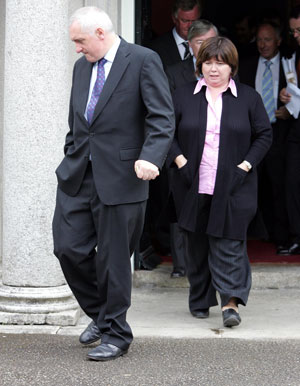
This photo, published in the Irish Times on 1st August, shows the Taoiseach and Tanaiste emerging from a special cabinet meeting in Avondale, Parnell's former home in Co Wicklow.
My Aunt Vyvyenne has drawn it to my attention with the comments that Bertie looks like he's been dressed by Oxfam while Mary might easily pass as the representative of the People's Republic of China.
How can people be so critical?
(Click on image to enlarge)
Thursday, August 17, 2006
Men's Liberation
Hats off to Dun Laoghaire Harbour Company and/or Stena Line.
Taking a pee in the gents at the ferry terminal today, I noticed a strange contraption attached to the wall.
Closer inspection revealed it to be a fold-down baby-changing table.
John Waters and I have been campaigning for such facilities for years, though I have no intention of ever using the thing.
A second observation:
Washing my hands, I noticed that the adjacent vending machine dispensed a variety of items - from mints to condoms.
I couldn't help wondering how often has some drunk wanting mints emerged with a packet of condoms, and vice versa?
Taking a pee in the gents at the ferry terminal today, I noticed a strange contraption attached to the wall.
Closer inspection revealed it to be a fold-down baby-changing table.
John Waters and I have been campaigning for such facilities for years, though I have no intention of ever using the thing.
A second observation:
Washing my hands, I noticed that the adjacent vending machine dispensed a variety of items - from mints to condoms.
I couldn't help wondering how often has some drunk wanting mints emerged with a packet of condoms, and vice versa?
Bono & the Tax System
Pity poor old Bono - he spends half his life working to relieve poverty and disease in the third world and, in an instant, his tax advisers have people calling for his head. Personally, I’d give him a “get out of jail free” card for his all good works, though I might be less well disposed towards the other fat cat members of the U2 corporation.
What we seem to forget is that, in a democratic society, the taxation system is the main mechanism for the redistribution of wealth. We don’t just pay taxes so that the road system can expand to accommodate our ever increasing number of cars, or for extra gardai and prison places to keep the proletariat in their place, or to keep government ministers in shiny new mercs each year. We also pay tax so that those in need can be supported, either directly through payments or indirectly through the provision of support services. The tax system also funds the national contribution to third world aid.
Aggressive tax-avoidance has to be recognised as anti-social behaviour, yet it is practiced by many of our wealthiest and most prominent citizens. Indeed, some of our most notable worthies claim to be non-resident for tax purposes, despite their presence at every dog-fight and dance here.
In his Irish Times column this week, Vincent Browne highlights the ludicrous situation where hospitals are dependent on charity to provide essential services which should be properly funded from the public purse. It’s easy to find lots of other examples e.g. run-down schools, over-crowded prisons, lack of affordable nursing home places etc..
Tax avoidance may not be a crime but neither is it victimless. Provided the taxation system is relatively fair and the administration is not overly corrupt, we all have a duty to contribute our fair share to the community chest of public funds.
Footnote: Published as a letter in the Irish Independent (twice by mistake!) & the Irish Examiner.
What we seem to forget is that, in a democratic society, the taxation system is the main mechanism for the redistribution of wealth. We don’t just pay taxes so that the road system can expand to accommodate our ever increasing number of cars, or for extra gardai and prison places to keep the proletariat in their place, or to keep government ministers in shiny new mercs each year. We also pay tax so that those in need can be supported, either directly through payments or indirectly through the provision of support services. The tax system also funds the national contribution to third world aid.
Aggressive tax-avoidance has to be recognised as anti-social behaviour, yet it is practiced by many of our wealthiest and most prominent citizens. Indeed, some of our most notable worthies claim to be non-resident for tax purposes, despite their presence at every dog-fight and dance here.
In his Irish Times column this week, Vincent Browne highlights the ludicrous situation where hospitals are dependent on charity to provide essential services which should be properly funded from the public purse. It’s easy to find lots of other examples e.g. run-down schools, over-crowded prisons, lack of affordable nursing home places etc..
Tax avoidance may not be a crime but neither is it victimless. Provided the taxation system is relatively fair and the administration is not overly corrupt, we all have a duty to contribute our fair share to the community chest of public funds.
Footnote: Published as a letter in the Irish Independent (twice by mistake!) & the Irish Examiner.
Wednesday, August 16, 2006
3rd World Twinning
This morning, Ryan Tubridy interviewed 3 Irish entrepreneurs who had visited Africa recently with Goal. The objective was for each man to identify an opportunity and help set up a business for local benefit.
I sent him the following email which he aired. I had originally suggested the idea about 12-18 months ago to a group associated with helping East Timor but they don't seem to have progressed it.
As you drive into any town in Ireland, you see the signs that tell you that this town is twinned with a community in France, Germany, USA etc..
I’ve always wondered why Concern, Trocaire, Goal etc haven’t set up a similar twinning programme with communities in the 3rd world. Wouldn’t it be great to see those signs on our roadsides?
Your interview with the entrepreneurs illustrate some of the benefits and skills that could be transferred. In addition to obvious fund-raising programmes, there are all sorts of exchange programmes that could benefit both communities. Even transition-year students (suitably supervised) could be involved in support programmes which would greatly benefit their own personal development as well as the 3rd world communities they are assisting.
For the Special Olympics towns and communities around Ireland acted as hosts to visiting athletes and their families. They did a fantastic job and the “host town” signs are still up around Ireland.
This suggests that there is a large appetite out there to do something tangible to help - but people need the organisational structure to get it moving.
I sent him the following email which he aired. I had originally suggested the idea about 12-18 months ago to a group associated with helping East Timor but they don't seem to have progressed it.
As you drive into any town in Ireland, you see the signs that tell you that this town is twinned with a community in France, Germany, USA etc..
I’ve always wondered why Concern, Trocaire, Goal etc haven’t set up a similar twinning programme with communities in the 3rd world. Wouldn’t it be great to see those signs on our roadsides?
Your interview with the entrepreneurs illustrate some of the benefits and skills that could be transferred. In addition to obvious fund-raising programmes, there are all sorts of exchange programmes that could benefit both communities. Even transition-year students (suitably supervised) could be involved in support programmes which would greatly benefit their own personal development as well as the 3rd world communities they are assisting.
For the Special Olympics towns and communities around Ireland acted as hosts to visiting athletes and their families. They did a fantastic job and the “host town” signs are still up around Ireland.
This suggests that there is a large appetite out there to do something tangible to help - but people need the organisational structure to get it moving.
Monday, August 14, 2006
Development in Dun Laoghaire
Following the publication of my post of 31st July as a letter in the Irish Times, it drew the following response from the Harbour Company, published 8th August, which is followed by my response, also published in the Irish Times on 17th August.
Madam,
Peter Molloy's interesting suggestion (August 1st) that the redevelopment of the public baths in Dun Laoghaire should be funded from the profits of Dun Laoghaire Harbour Company unfortunately ignores the commercial realities which the harbour company has to deal with every day.
His conclusion that the company is highly profitable is based on his analysis of its published annual accounts for 2002, which show a profit after tax for the year of €2.5 million. The harbour company's after-tax profit in 2005 was €2.7 million - a growth rate which has failed to keep pace with inflation in the intervening period. There is one very obvious reason for this: the decline in passenger numbers through the ferry terminal. In 2002 ferry passenger numbers amounted to 1,015,000; in 2005 the figure was 851,000.
Over the same period the company has had to deal with the rising cost of maintaining and repairing the harbour. The recent refurbishment of the lower level of the East Pier, for example, cost about €3 million. Work which is about to begin on repairs to the structures of both the East and West Piers will cost more than €10 million. The harbour company spends about €3 million a year on the conservation of the historic harbour as a public facility to be enjoyed by this and future generations - and it is committed to doing so for the foreseeable future without recourse to the taxpayer.
As we are a state commercial company which receives no funding from the State, we have to rely on our profits to generate the funds necessary to carry out this work.
This is why the company is pursuing new sources of revenue. The marina and the Crofton Road development are two very obvious examples of this. We expect the redevelopment of Carlisle Pier to be another. The company cannot contemplate the redevelopment of the pier without the realistic expectation that it will generate a reasonable profit.
Unfortunately, the Dun Laoghaire Harbour Company is not now and is unlikely, for the foreseeable future, to be able to contribute from its profits to the redevelopment of the public baths by Dun Laoghaire Rathdown County Council. However, the company does contribute €700,000 a year in commercial rates to the council. In addition, it contributes about €1 million a year to the State in corporation tax and VAT. Both figures are likely to grow substantially when Carlisle Pier is redeveloped.
This company already makes a substantial and growing financial contribution to the Exchequer and the county council. If the recipients of those contributions were to direct them towards the redevelopment of the public baths, most reasonable people would see this as a sensible and appropriate use of funds generated by Dun Laoghaire's waterfront. - Yours, etc,
MICHAEL HANAHOE, Chief Executive, Dun Laoghaire Harbour Company
My response, published 17th August:
Madam,
Having been abroad, I’ve just seen Michael Hanahoe’s response (8th August) to my suggestion (1st August) regarding the possibility of cross-funding Dun Laoghaire Baths from the successful Dun Laoghaire Harbour Company. It is indeed nice to see an all too rare example in these Celtic Tiger times of the once popular irish tradition of “an beal botch“.
However, as chief executive of the Harbour Company, his desire to quickly insert a forty-foot pole between his company and the financial white elephant of a re-instituted public baths is entirely understandable. If the baths are re-opened in their current format they will continue to lose money. It’s a sad fact that most of the middle-classes who protested last year had probably never used the baths when they were open and will never use them if they’re re-opened.
However, a decision on the future of the baths is required and it is ultimately a political one. If the baths are deemed to need an ongoing subsidy then this must be provided from either local or central government funds. If neither is willing to commit to such a subvention, then the baths should be demolished to allow continuous public access along the seafront and/or the site to be used for some commercial purpose.
Last year’s protests have scared local politicians and the County Council is unlikely to propose any new initiative for fear of another backlash. Consequently, we could be faced with years, if not decades, of inaction on this bricked-up and derelict eyesore in a prominent location on Dun Laoghaire seafront.
The Harbour Company, on the other hand, has displayed a willingness to take commercial decisions and risk public disfavour, as exemplified by the selection of one of the less-favoured designs for the Carlisle Pier development.
If a commercially viable solution is required, then it might make sense to transfer ownership of the baths to the Harbour Company with a mandate to effect the necessary changes, even if Mr Hanahoe doesn’t want this particular political and financial monkey.
Regards etc..
Madam,
Peter Molloy's interesting suggestion (August 1st) that the redevelopment of the public baths in Dun Laoghaire should be funded from the profits of Dun Laoghaire Harbour Company unfortunately ignores the commercial realities which the harbour company has to deal with every day.
His conclusion that the company is highly profitable is based on his analysis of its published annual accounts for 2002, which show a profit after tax for the year of €2.5 million. The harbour company's after-tax profit in 2005 was €2.7 million - a growth rate which has failed to keep pace with inflation in the intervening period. There is one very obvious reason for this: the decline in passenger numbers through the ferry terminal. In 2002 ferry passenger numbers amounted to 1,015,000; in 2005 the figure was 851,000.
Over the same period the company has had to deal with the rising cost of maintaining and repairing the harbour. The recent refurbishment of the lower level of the East Pier, for example, cost about €3 million. Work which is about to begin on repairs to the structures of both the East and West Piers will cost more than €10 million. The harbour company spends about €3 million a year on the conservation of the historic harbour as a public facility to be enjoyed by this and future generations - and it is committed to doing so for the foreseeable future without recourse to the taxpayer.
As we are a state commercial company which receives no funding from the State, we have to rely on our profits to generate the funds necessary to carry out this work.
This is why the company is pursuing new sources of revenue. The marina and the Crofton Road development are two very obvious examples of this. We expect the redevelopment of Carlisle Pier to be another. The company cannot contemplate the redevelopment of the pier without the realistic expectation that it will generate a reasonable profit.
Unfortunately, the Dun Laoghaire Harbour Company is not now and is unlikely, for the foreseeable future, to be able to contribute from its profits to the redevelopment of the public baths by Dun Laoghaire Rathdown County Council. However, the company does contribute €700,000 a year in commercial rates to the council. In addition, it contributes about €1 million a year to the State in corporation tax and VAT. Both figures are likely to grow substantially when Carlisle Pier is redeveloped.
This company already makes a substantial and growing financial contribution to the Exchequer and the county council. If the recipients of those contributions were to direct them towards the redevelopment of the public baths, most reasonable people would see this as a sensible and appropriate use of funds generated by Dun Laoghaire's waterfront. - Yours, etc,
MICHAEL HANAHOE, Chief Executive, Dun Laoghaire Harbour Company
My response, published 17th August:
Madam,
Having been abroad, I’ve just seen Michael Hanahoe’s response (8th August) to my suggestion (1st August) regarding the possibility of cross-funding Dun Laoghaire Baths from the successful Dun Laoghaire Harbour Company. It is indeed nice to see an all too rare example in these Celtic Tiger times of the once popular irish tradition of “an beal botch“.
However, as chief executive of the Harbour Company, his desire to quickly insert a forty-foot pole between his company and the financial white elephant of a re-instituted public baths is entirely understandable. If the baths are re-opened in their current format they will continue to lose money. It’s a sad fact that most of the middle-classes who protested last year had probably never used the baths when they were open and will never use them if they’re re-opened.
However, a decision on the future of the baths is required and it is ultimately a political one. If the baths are deemed to need an ongoing subsidy then this must be provided from either local or central government funds. If neither is willing to commit to such a subvention, then the baths should be demolished to allow continuous public access along the seafront and/or the site to be used for some commercial purpose.
Last year’s protests have scared local politicians and the County Council is unlikely to propose any new initiative for fear of another backlash. Consequently, we could be faced with years, if not decades, of inaction on this bricked-up and derelict eyesore in a prominent location on Dun Laoghaire seafront.
The Harbour Company, on the other hand, has displayed a willingness to take commercial decisions and risk public disfavour, as exemplified by the selection of one of the less-favoured designs for the Carlisle Pier development.
If a commercially viable solution is required, then it might make sense to transfer ownership of the baths to the Harbour Company with a mandate to effect the necessary changes, even if Mr Hanahoe doesn’t want this particular political and financial monkey.
Regards etc..
The PDs bite back!
Following publication of my entry of 31st July in the Indo, the PDs had a response published on 10th August, which I reproduce below. This is followed by my own response to the PD rebuttal.
I read with interest Peter Molloy's 'A Prayer for the poor PD's' (Letters, August 4) with some amusement. It is a long time since I have seen the word gombeen used in Irish political discourse; in fact I am sure in fact that many of your younger readers will have no idea what it means. When I was growing up it referred to a style of politics dominated by personality politics and clientalism.
It is clear from Mr Molloy's letter that he is himself is a practitioner of this style of politics as all his criticisms of the Progressive Democrats are focused on issues of personality rather than issues of policy. I had thought that we as a society had moved beyond such a trivial analysis of political matters.
Mr Molloy appears to believe that Tom Parlon is a gombeen politician. I had the pleasure recently of seeing Minister Parlon chair a meeting of farmers in his own constituency. During the meeting a suggestion was made from the floor on a matter of policy which was to say the least impracticable. The response of any Gombeen politician would have been to make soothing noises, promise to raise the issue at the highest level etc. The Minister did not give that response he said straight out it was a bad idea, and why it was a bad idea. Straight talk is not the mark of a Gombeen politician.
Mr Molloy appears to believe that Minister McDowell is unfit for office because he lost his temper, and that he has become "increasingly belligerent".
No one would claim that Minister McDowell is a shy, shrinking violet, but then again who would want a shrinking violet as Minster for Justice?
Minister McDowell had the courage to stand up to Sinn Fein when the overwhelming consensus was that a blind eye should be turned to their crimes, when see no evil seemed to be the public motto. Nor has he been afraid to push through vital reforms in law enforcement in the face of concerted opposition from powerful vested interests. His judgement has been questioned, but more often vindicated.
When Minister McDowell lost his temper, he made a full and gracious apology on the floor of the house; if it was good enough for Richard Bruton surely it should be good enough for Mr Molloy.
Minister McDowell is a refreshing change, a politician who knows his mind and is unafraid to speak it in a forthright and fearless fashion.
Finally, Mr Molloy has the absolute temerity to question Tanaiste's competence.
There can be no doubt that the single greatest challenge facing the Irish political system is the provision of a proper Healthcare system for the Irish people. Irish taxpayers are paying for a world class Healthcare system and Minister Mary Harney is working both hard and smart to make sure they get one.
It is a huge challenge; indeed it is the largest change management exercise in the history of the State. I know of no other politician who would have either the courage to accept the task, let alone to deliberately seek it out, or the skill to bring it to a successful conclusion.
Progress is being made, slowly and painfully perhaps, but real progress nonetheless. The Tanaiste is a woman of acute intelligence, great political skill, and no little compassion. All attributes she will need to deliver the promise of a world class Health Service. I have no doubt she will do so.
On one point only do I agree with Mr Molloy, the fate of the Progressive Democrats (and indeed of every politician in Dail Eireann ) lies in the hands of God and the Irish people. To God I commend our souls and the souls of all in politics, to the Irish people I commend the Progressive Democrats.
SEAMUS MULCONRY,
DIRECTOR OF POLICY
PROGRESSIVE DEMOCRATS,
STH FREDERICK ST D2
My response emailed Sunday 13th August
Dear Sir,
I refer to Seamus Mulconry‘s response (10th August) on behalf of the PDs to my earlier analysis (4th August) of the party’s situation. I doubt your readers required his help in understanding the meaning of “gombeen politics”. They only have to think “Parlon Country” to conjure up an appropriate image of self-serving cute-hoorism. It’s not a question of intelligence or competence, it’s a question of how those attributes are applied.
Mr Mulconry offers a robust defence of Michael McDowell, a man of undoubted ability and intelligence. However, the minister’s outburst against Richard Bruton was only the latest in a series of gaffes which place serious question-marks over his political judgement. Other include the highly controversial provision of confidential garda information on the Columbia Three case to a selected journalist and a series of high-profile policy u-turns forced on him by his government colleagues, most recently the decision to legalise gambling clubs.
Finally, Mr Mulconry has the brass-neck to accuse me of having “the absolute temerity to question the Tanaiste's competence” as, in my letter of 4th August, I stated that “few people doubt her integrity or work ethic, but her competence is now being called into question by her apparent inability to achieve significant improvement in the health service or to break the hold of the powerful vested interests - the consultants, nurses etc - in that service.”
If Mr Mulconry thinks that the public and the media are already declaring the Tanaiste's tenure a success in the Health arena, then I suspect that he needs to do more research in his role as PD Director of Policy.
Regards etc.
I read with interest Peter Molloy's 'A Prayer for the poor PD's' (Letters, August 4) with some amusement. It is a long time since I have seen the word gombeen used in Irish political discourse; in fact I am sure in fact that many of your younger readers will have no idea what it means. When I was growing up it referred to a style of politics dominated by personality politics and clientalism.
It is clear from Mr Molloy's letter that he is himself is a practitioner of this style of politics as all his criticisms of the Progressive Democrats are focused on issues of personality rather than issues of policy. I had thought that we as a society had moved beyond such a trivial analysis of political matters.
Mr Molloy appears to believe that Tom Parlon is a gombeen politician. I had the pleasure recently of seeing Minister Parlon chair a meeting of farmers in his own constituency. During the meeting a suggestion was made from the floor on a matter of policy which was to say the least impracticable. The response of any Gombeen politician would have been to make soothing noises, promise to raise the issue at the highest level etc. The Minister did not give that response he said straight out it was a bad idea, and why it was a bad idea. Straight talk is not the mark of a Gombeen politician.
Mr Molloy appears to believe that Minister McDowell is unfit for office because he lost his temper, and that he has become "increasingly belligerent".
No one would claim that Minister McDowell is a shy, shrinking violet, but then again who would want a shrinking violet as Minster for Justice?
Minister McDowell had the courage to stand up to Sinn Fein when the overwhelming consensus was that a blind eye should be turned to their crimes, when see no evil seemed to be the public motto. Nor has he been afraid to push through vital reforms in law enforcement in the face of concerted opposition from powerful vested interests. His judgement has been questioned, but more often vindicated.
When Minister McDowell lost his temper, he made a full and gracious apology on the floor of the house; if it was good enough for Richard Bruton surely it should be good enough for Mr Molloy.
Minister McDowell is a refreshing change, a politician who knows his mind and is unafraid to speak it in a forthright and fearless fashion.
Finally, Mr Molloy has the absolute temerity to question Tanaiste's competence.
There can be no doubt that the single greatest challenge facing the Irish political system is the provision of a proper Healthcare system for the Irish people. Irish taxpayers are paying for a world class Healthcare system and Minister Mary Harney is working both hard and smart to make sure they get one.
It is a huge challenge; indeed it is the largest change management exercise in the history of the State. I know of no other politician who would have either the courage to accept the task, let alone to deliberately seek it out, or the skill to bring it to a successful conclusion.
Progress is being made, slowly and painfully perhaps, but real progress nonetheless. The Tanaiste is a woman of acute intelligence, great political skill, and no little compassion. All attributes she will need to deliver the promise of a world class Health Service. I have no doubt she will do so.
On one point only do I agree with Mr Molloy, the fate of the Progressive Democrats (and indeed of every politician in Dail Eireann ) lies in the hands of God and the Irish people. To God I commend our souls and the souls of all in politics, to the Irish people I commend the Progressive Democrats.
SEAMUS MULCONRY,
DIRECTOR OF POLICY
PROGRESSIVE DEMOCRATS,
STH FREDERICK ST D2
My response emailed Sunday 13th August
Dear Sir,
I refer to Seamus Mulconry‘s response (10th August) on behalf of the PDs to my earlier analysis (4th August) of the party’s situation. I doubt your readers required his help in understanding the meaning of “gombeen politics”. They only have to think “Parlon Country” to conjure up an appropriate image of self-serving cute-hoorism. It’s not a question of intelligence or competence, it’s a question of how those attributes are applied.
Mr Mulconry offers a robust defence of Michael McDowell, a man of undoubted ability and intelligence. However, the minister’s outburst against Richard Bruton was only the latest in a series of gaffes which place serious question-marks over his political judgement. Other include the highly controversial provision of confidential garda information on the Columbia Three case to a selected journalist and a series of high-profile policy u-turns forced on him by his government colleagues, most recently the decision to legalise gambling clubs.
Finally, Mr Mulconry has the brass-neck to accuse me of having “the absolute temerity to question the Tanaiste's competence” as, in my letter of 4th August, I stated that “few people doubt her integrity or work ethic, but her competence is now being called into question by her apparent inability to achieve significant improvement in the health service or to break the hold of the powerful vested interests - the consultants, nurses etc - in that service.”
If Mr Mulconry thinks that the public and the media are already declaring the Tanaiste's tenure a success in the Health arena, then I suspect that he needs to do more research in his role as PD Director of Policy.
Regards etc.
Thursday, August 03, 2006
How is it in your ideal world?
Our daily lives are highly complex affairs, though we rarely recognise that fact.
We interact with a myriad of people - family, friends, acquaintances, colleagues and strangers. Some interactions are planned, many are unplanned. We have prepared responses and we are also required to make many off-the-cuff responses.
We make good decisions, imperfect decisions and outright mistakes.
The good decisions may often involve the telling of lies, the use of flattery, the biting of tongues, the deliberate avoidance of the perceived truth.
The sub-optimal decisions are generally, though not always, arrived at without malice. We misjudge other people’s motivation or needs. We’re in a hurry. We’re not interested. We’ve already made our mind up. We’re deliberately provoked. We lack or lose patience. We act on imperfect or incomplete information or knowledge. We react to what has been done or said by the other party, or pre-empting what we expect as their contribution/reaction, or seeking to settle an old score. We act on something we’ve been told by a third party, which proves to be incorrect.
Sometimes the problem arises because the other party misunderstands what we mean to express or our intent, for good or ill, and an unexpected and unpredicted scenario develops. They arrive at our interaction with their own set of possible inputs and outcomes, so it’s fraught with a double dose of potential for misunderstanding.
Our daily lives are filled with such situations. Depending on how they are evolving before our eyes we make a number of decisions. We change tack. We bite our tongue. We compromise. We attack. We retreat. We kiss and make up. We shut up. We listen. We learn. We apologise. We walk away. Whatever.
Our own lives are a microcosm of national and international politics, but thankfully most of us are only burdened with a fraction of the potential complexities.
Media commentators have lives that are equally complicated. Indeed, with wealth, fame and the circles they move in, they probably have ample opportunity to complicate their lives even more.
Yet put them in front of a microphone and the same media people allow no such ambiguities. They offer black and white analysis of some imaginary black and white world that simply doesn’t exist and has never existed - for us or for them. They demand yes/no answers. They not only want definitive answers and explanations to existing problems and situations, but they want answers to hypothetical future situations - “what will you do if….” etc.. Often these hypothetical scenarios have the potential to exacerbate an already overheated situation if the response is seen or heard by the opposing party to the dispute under discussion.
The media make it virtually impossible for politicians to do what we do every day in our own lives - change their mind, compromise etc.. And, God help us, most politicians seem to collude in this nonsense.
Whatever chance exists to resolve international disputes, I suspect that the role of the media is definitely a double-edged sword. How would any of us, or our relationships, survive if we were forced to endure the equivalent of scrutiny by 24-hour reality TV but with the added twist that we were also subjected to constant interrogation, often of a speculative nature? With everyone you know and don’t know watching.
It's time to call a halt!
We interact with a myriad of people - family, friends, acquaintances, colleagues and strangers. Some interactions are planned, many are unplanned. We have prepared responses and we are also required to make many off-the-cuff responses.
We make good decisions, imperfect decisions and outright mistakes.
The good decisions may often involve the telling of lies, the use of flattery, the biting of tongues, the deliberate avoidance of the perceived truth.
The sub-optimal decisions are generally, though not always, arrived at without malice. We misjudge other people’s motivation or needs. We’re in a hurry. We’re not interested. We’ve already made our mind up. We’re deliberately provoked. We lack or lose patience. We act on imperfect or incomplete information or knowledge. We react to what has been done or said by the other party, or pre-empting what we expect as their contribution/reaction, or seeking to settle an old score. We act on something we’ve been told by a third party, which proves to be incorrect.
Sometimes the problem arises because the other party misunderstands what we mean to express or our intent, for good or ill, and an unexpected and unpredicted scenario develops. They arrive at our interaction with their own set of possible inputs and outcomes, so it’s fraught with a double dose of potential for misunderstanding.
Our daily lives are filled with such situations. Depending on how they are evolving before our eyes we make a number of decisions. We change tack. We bite our tongue. We compromise. We attack. We retreat. We kiss and make up. We shut up. We listen. We learn. We apologise. We walk away. Whatever.
Our own lives are a microcosm of national and international politics, but thankfully most of us are only burdened with a fraction of the potential complexities.
Media commentators have lives that are equally complicated. Indeed, with wealth, fame and the circles they move in, they probably have ample opportunity to complicate their lives even more.
Yet put them in front of a microphone and the same media people allow no such ambiguities. They offer black and white analysis of some imaginary black and white world that simply doesn’t exist and has never existed - for us or for them. They demand yes/no answers. They not only want definitive answers and explanations to existing problems and situations, but they want answers to hypothetical future situations - “what will you do if….” etc.. Often these hypothetical scenarios have the potential to exacerbate an already overheated situation if the response is seen or heard by the opposing party to the dispute under discussion.
The media make it virtually impossible for politicians to do what we do every day in our own lives - change their mind, compromise etc.. And, God help us, most politicians seem to collude in this nonsense.
Whatever chance exists to resolve international disputes, I suspect that the role of the media is definitely a double-edged sword. How would any of us, or our relationships, survive if we were forced to endure the equivalent of scrutiny by 24-hour reality TV but with the added twist that we were also subjected to constant interrogation, often of a speculative nature? With everyone you know and don’t know watching.
It's time to call a halt!
Wednesday, August 02, 2006
King of the Pygmies
On Channel 4 News tonight, Sir Christopher Meyer was a contributor on the steps necessary to resolve the overall problem in the Middle East.
In response to one of the other contributors who made the point that both Hamas and Hizbollah are dedicated to the destruction of Israel, Meyer made reference to the lessons learnt in the Northern Ireland peace process and pointed out that the constitution of the Republic of Ireland laid claim to the territory of Northern Ireland.
That Meyer saw this as being relevant to the situation in the Middle East shows a shallowness of thinking that is breath-taking. The Republic of Ireland never made, or even threatened, any effort by force to put that territorial claim into effect. The contrast with both the words and the actions of Israel’s neighbours could hardly be greater.
When this man was UK ambassador in Washington, there were clearly more pygmies running about than those identified in his memoirs!
In response to one of the other contributors who made the point that both Hamas and Hizbollah are dedicated to the destruction of Israel, Meyer made reference to the lessons learnt in the Northern Ireland peace process and pointed out that the constitution of the Republic of Ireland laid claim to the territory of Northern Ireland.
That Meyer saw this as being relevant to the situation in the Middle East shows a shallowness of thinking that is breath-taking. The Republic of Ireland never made, or even threatened, any effort by force to put that territorial claim into effect. The contrast with both the words and the actions of Israel’s neighbours could hardly be greater.
When this man was UK ambassador in Washington, there were clearly more pygmies running about than those identified in his memoirs!
No heroes in Lebanon
Israel bombards Lebanon, attempting to avoid killing civilians but failing.
Hizbollah bombards Israel, attempting to kill civilians but failing.
A plague on both their houses.
Footnote: Published as a leter in the Irish Independent.
Hizbollah bombards Israel, attempting to kill civilians but failing.
A plague on both their houses.
Footnote: Published as a leter in the Irish Independent.
Monday, July 31, 2006
Anyone for swimming or just going through the motions?
Another summer passes and the eyesore of the former public baths on Dun Laoghaire seafront remains bricked up.
Dun Laoghaire-Rathdown Co Council (DLRCoCo) claim that any development project must be self-financing unless aid is provided by the Dept of the Environment.
DLRCoCo’s own proposal last year was scuppered by protests from largely "muddle-class" marchers - those who never used the facility when it was open and will never use it if it is re-opened. To date, there is no sign of support from Minister Dick Roche.
Within spitting distance of the long-derelict baths is Dun Laoghaire harbour. This public asset is owned and managed by Dun Laoghaire Harbour Company, a semi-state company whose sole shareholder is The Minister for Communications, Marine and Natural Resources.
The Harbour company made a profit of €2.5m in 2002, the last accounts available on their website. The Harbour company generates income from the various users of the harbour e.g. the Stena Line, Irish Lights, the various yacht clubs etc.. It also owns the recently built and very successful marina which will have further boosted those annual profits in the interim.
In addition, the Harbour Company is currently involved in the Harbour Yard development of a major office, shop and apartment complex beside the Town Hall. The delayed Carlisle Pier development will ultimately provide another huge boost to the finances of the Harbour Company.
Consequently, the Harbour Company has a strong and growing revenue stream, with major incremental annual revenues due from the Harbour Yard and Carlisle Pier developments when these are completed over the next few years.
These assets are all owned by the taxpayer, but the revenues generated are ring-fenced and only applied to the actual areas under the direct control of the Harbour Company itself.
In summary, the taxpayer owns both the highly profitable harbour and the derelict baths but there does not appear to be any current mechanism for to use funds from one to refurbish and run the other. Surely the relevant Government ministers - Dick Roche (Environment) and Noel Dempsey ( Communications, Marine & Natural Resources) should be capable of resolving this anomaly?
Then again, probably not.
Footnote: A slight variant of this published as a letter in the Irish Times.
Dun Laoghaire-Rathdown Co Council (DLRCoCo) claim that any development project must be self-financing unless aid is provided by the Dept of the Environment.
DLRCoCo’s own proposal last year was scuppered by protests from largely "muddle-class" marchers - those who never used the facility when it was open and will never use it if it is re-opened. To date, there is no sign of support from Minister Dick Roche.
Within spitting distance of the long-derelict baths is Dun Laoghaire harbour. This public asset is owned and managed by Dun Laoghaire Harbour Company, a semi-state company whose sole shareholder is The Minister for Communications, Marine and Natural Resources.
The Harbour company made a profit of €2.5m in 2002, the last accounts available on their website. The Harbour company generates income from the various users of the harbour e.g. the Stena Line, Irish Lights, the various yacht clubs etc.. It also owns the recently built and very successful marina which will have further boosted those annual profits in the interim.
In addition, the Harbour Company is currently involved in the Harbour Yard development of a major office, shop and apartment complex beside the Town Hall. The delayed Carlisle Pier development will ultimately provide another huge boost to the finances of the Harbour Company.
Consequently, the Harbour Company has a strong and growing revenue stream, with major incremental annual revenues due from the Harbour Yard and Carlisle Pier developments when these are completed over the next few years.
These assets are all owned by the taxpayer, but the revenues generated are ring-fenced and only applied to the actual areas under the direct control of the Harbour Company itself.
In summary, the taxpayer owns both the highly profitable harbour and the derelict baths but there does not appear to be any current mechanism for to use funds from one to refurbish and run the other. Surely the relevant Government ministers - Dick Roche (Environment) and Noel Dempsey ( Communications, Marine & Natural Resources) should be capable of resolving this anomaly?
Then again, probably not.
Footnote: A slight variant of this published as a letter in the Irish Times.
Pity the PDs
The latest Sunday Business Post opinion poll shows the PDs down to an all-time low of 2%. They must surely be facing melt-down in next year’s general election unless something dramatic happens in the interim to improve their prospects.
When Dessie O’Malley founded the PDs in 1985, one of the party’s main selling points was a commitment to decommission the gombeen in Irish politics. Then they foolishly recruited Tom Parlon in 2002. I need say no more.
In the past couple of years, Michael McDowell has become increasingly belligerent, climaxing this year in his hysterical attack on Richard Bruton when he clearly lost all sense of proportion and went totally over the top. This has raised serious question marks over his suitability to hold senior Government office, particularly in a very sensitive ministry such as Justice.
McDowell’s recent leadership spat with Mary Harney has further damaged both himself and the party. He seems to have shot himself in the foot as far as future leadership of the PDs is concerned. On top of all this, his authority in cabinet has been systematically undermined and he’s been forced to make a number of high profile policy changes, most recently on the issue of private gambling clubs. It’s hard to see a man of his ego taking such public humiliations for long. A return to the Law Library should not be ruled out.
Then there’s Mary Harney herself. Few people doubt her integrity or work ethic, but her competence is now being called into question by her apparent inability to achieve significant improvement in the health service or to break the hold of the powerful vested interests - the consultants, nurses etc - in that service. Unless there’s a material breakthrough before the general election, her decision to take the Health portfolio will be officially categorised as “brave but politically naïve”.
As things stand, the PDs are in the Dail A&E and the prognosis is not good. Pray for them - either for a recovery or a happy death - depending on your political outlook.
Footnote: Published as a letter in the Irish Independent. Also, the opening section on Tom Parlon was aired by Rachel English on RTE's 5-7 Live radio programme and drew an instant rebuke for RTE from the PDs.
When Dessie O’Malley founded the PDs in 1985, one of the party’s main selling points was a commitment to decommission the gombeen in Irish politics. Then they foolishly recruited Tom Parlon in 2002. I need say no more.
In the past couple of years, Michael McDowell has become increasingly belligerent, climaxing this year in his hysterical attack on Richard Bruton when he clearly lost all sense of proportion and went totally over the top. This has raised serious question marks over his suitability to hold senior Government office, particularly in a very sensitive ministry such as Justice.
McDowell’s recent leadership spat with Mary Harney has further damaged both himself and the party. He seems to have shot himself in the foot as far as future leadership of the PDs is concerned. On top of all this, his authority in cabinet has been systematically undermined and he’s been forced to make a number of high profile policy changes, most recently on the issue of private gambling clubs. It’s hard to see a man of his ego taking such public humiliations for long. A return to the Law Library should not be ruled out.
Then there’s Mary Harney herself. Few people doubt her integrity or work ethic, but her competence is now being called into question by her apparent inability to achieve significant improvement in the health service or to break the hold of the powerful vested interests - the consultants, nurses etc - in that service. Unless there’s a material breakthrough before the general election, her decision to take the Health portfolio will be officially categorised as “brave but politically naïve”.
As things stand, the PDs are in the Dail A&E and the prognosis is not good. Pray for them - either for a recovery or a happy death - depending on your political outlook.
Footnote: Published as a letter in the Irish Independent. Also, the opening section on Tom Parlon was aired by Rachel English on RTE's 5-7 Live radio programme and drew an instant rebuke for RTE from the PDs.
Sunday, July 30, 2006
Anyone for "peace in our time"?
It is not anti-semitic to condemn as disproportionate Israel’s recent military retaliation in Lebanon and Gaza.
It is anti-semitic to deny the holocaust or the betrayal of jews by their fellow citizens in most occupied European countries during WWII.
It may not be anti-semitic but it is certainly illogical to deny Israel’s right to treat the public statements of politicians such as Iran’s President Mahmoud Ahmadinejad as more than mere rhetoric.
The jews have learned, to their cost and our collective European shame, that sometimes threats of extermination are actually real. Sadly, they have also learnt the hard way that the only people they can ultimately rely on in a crisis are themselves.
The failure of the international community or the UN to take any action against the Iranians for these public pronouncements by their President suggests that such sentiments do not merit much by way of outrage. Shades of pre-war Germany again.
------------------------------------------------------------
It is not undemocratic to denounce President George Bush despite his democratic mandate achieved in two elections. Both his election and the ability to denounce his electoral success are integral components of the democratic system. Yet those who most vehemently deny his legitimacy are the very ones who demand that Israel respects the democratic choice of the Palestinians and deal with Hamas.
It is undemocratic to use a democratic electoral system to legitimise a political philosophy of “the ballot box and the bullet”, as both Hamas and Hizbollah have done. Again, the Jews know, from the success of the Nazi Party in the German elections of 1933, that a democratic process is no guarantee of a democratic outcome.
It may not be anti-semitic but it is certainly illogical to demand that Israel negotiate with groups whose stated position is the elimination of the Jewish state from the face of the earth. How exactly do you negotiate terms for your own extermination?
Those who argue that Hamas are the democratically elected government of the Palestinians and, as such, the Israelis are bound to negotiate with them might just as well claim that the Nazis were the democratically elected government of Germany and were therefore entitled to pursue any policy they chose to with regard to ethnic or religious minorities.
--------------------------------------------------------------
The seemingly intractable dispute in the Middle East is an infuriatingly complex mix of right and wrong on both sides, fuelled by the ongoing interventions of regional powers who often seek to use it as surrogate cockpit to fight the West in general and the US in particular, rather than a pursuit of the legitimate rights of the Palestinians. With all the oil wealth in the Middle East, how come the Palestinians are so impoverished? Where is evidence of financial support from their arab/islamic neighbours?
This problem will not be resolved through the barrel of a gun but neither will it resolved by the pious platitudes of mealy-mouthed, hand-wringing liberals (picture Michael D Higgins) who view the world through rose-tinted spectacles and promote no solution which would give Israel long-term security from organisations such as Hizbollah.
These are the very people who would happily vote for Chamberlain-style appeasement of terrorism and fundamentalism. Remind me - just how long did “peace in our time” last?
It is anti-semitic to deny the holocaust or the betrayal of jews by their fellow citizens in most occupied European countries during WWII.
It may not be anti-semitic but it is certainly illogical to deny Israel’s right to treat the public statements of politicians such as Iran’s President Mahmoud Ahmadinejad as more than mere rhetoric.
The jews have learned, to their cost and our collective European shame, that sometimes threats of extermination are actually real. Sadly, they have also learnt the hard way that the only people they can ultimately rely on in a crisis are themselves.
The failure of the international community or the UN to take any action against the Iranians for these public pronouncements by their President suggests that such sentiments do not merit much by way of outrage. Shades of pre-war Germany again.
------------------------------------------------------------
It is not undemocratic to denounce President George Bush despite his democratic mandate achieved in two elections. Both his election and the ability to denounce his electoral success are integral components of the democratic system. Yet those who most vehemently deny his legitimacy are the very ones who demand that Israel respects the democratic choice of the Palestinians and deal with Hamas.
It is undemocratic to use a democratic electoral system to legitimise a political philosophy of “the ballot box and the bullet”, as both Hamas and Hizbollah have done. Again, the Jews know, from the success of the Nazi Party in the German elections of 1933, that a democratic process is no guarantee of a democratic outcome.
It may not be anti-semitic but it is certainly illogical to demand that Israel negotiate with groups whose stated position is the elimination of the Jewish state from the face of the earth. How exactly do you negotiate terms for your own extermination?
Those who argue that Hamas are the democratically elected government of the Palestinians and, as such, the Israelis are bound to negotiate with them might just as well claim that the Nazis were the democratically elected government of Germany and were therefore entitled to pursue any policy they chose to with regard to ethnic or religious minorities.
--------------------------------------------------------------
The seemingly intractable dispute in the Middle East is an infuriatingly complex mix of right and wrong on both sides, fuelled by the ongoing interventions of regional powers who often seek to use it as surrogate cockpit to fight the West in general and the US in particular, rather than a pursuit of the legitimate rights of the Palestinians. With all the oil wealth in the Middle East, how come the Palestinians are so impoverished? Where is evidence of financial support from their arab/islamic neighbours?
This problem will not be resolved through the barrel of a gun but neither will it resolved by the pious platitudes of mealy-mouthed, hand-wringing liberals (picture Michael D Higgins) who view the world through rose-tinted spectacles and promote no solution which would give Israel long-term security from organisations such as Hizbollah.
These are the very people who would happily vote for Chamberlain-style appeasement of terrorism and fundamentalism. Remind me - just how long did “peace in our time” last?
Making sense of it all.
If, like me, you believe that 9/11 was a "Pearl Harbour" event, a declaration of world war by Islamic extremism on the West in general, then you’d have to conclude that while we have been cursed by our enemies, we often feel cursed with our allies.
Thursday, July 27, 2006
Balance on RTE
It's hard to miss Tom McGurk's political slant while listening to his morning radio programme on RTE. He has the annoying habit of asking closed questions, where he fashions the question to refect his preconceived view "Would you not agree that ..... etc etc".. Thankfully it has frequently happened that his presumptions are rebutted by his contributors, but he persists with the approach. It's sounds like lazy arrogance at times.
He was off again this morning, so I felt obliged to send him the following email (tom@rte.ie):
Tom,
On the programme today (Thurs 27th) you interviewed Alec Salmond(SNP) regarding the use of Prestwick by the US to transport "bunker-buster" bombs to Israel. You commented on the irony that these bombs had been used to kill the 4 UN observers in south Lebanon.
In today's Irish Times, Tom Clonan, a military commentator used by yourself in recent days, assesses that the weapon was in fact "a laser-guided 1,00kg bomb" - a large but fairly standard aerial weapon, definitely not a "bunker-buster".
You also interviewed Michael D Higgins who cited a total of 1,500 killed to date in Lebanon, naturally without any query or contradiction from yourself. RTE News this evening is quoting the Lebanese government as estimating up to 600 killed (400 bodies actually accounted for and making allowance for another 50% which may be unreported to date).
You say that your producer refuses to let you choose the music played on the programme. I suggest that he/she has a much larger and more important task to perform - the injection of appropriate levels of balance and professionalism into your coverage of this hugely important topic. Regards etc.
He was off again this morning, so I felt obliged to send him the following email (tom@rte.ie):
Tom,
On the programme today (Thurs 27th) you interviewed Alec Salmond(SNP) regarding the use of Prestwick by the US to transport "bunker-buster" bombs to Israel. You commented on the irony that these bombs had been used to kill the 4 UN observers in south Lebanon.
In today's Irish Times, Tom Clonan, a military commentator used by yourself in recent days, assesses that the weapon was in fact "a laser-guided 1,00kg bomb" - a large but fairly standard aerial weapon, definitely not a "bunker-buster".
You also interviewed Michael D Higgins who cited a total of 1,500 killed to date in Lebanon, naturally without any query or contradiction from yourself. RTE News this evening is quoting the Lebanese government as estimating up to 600 killed (400 bodies actually accounted for and making allowance for another 50% which may be unreported to date).
You say that your producer refuses to let you choose the music played on the programme. I suggest that he/she has a much larger and more important task to perform - the injection of appropriate levels of balance and professionalism into your coverage of this hugely important topic. Regards etc.
McDaid's Donegal U-turn
It should come as no surprise that Deputy Jim McDaid has done a u-turn on his decision to retire from politics at the next election.
Earlier this year, it emerged that Doctor McDaid had returned full-time to medical practice for several months and yet no-one - his political colleagues, his Donegal constituents or the national or local media - seemed to have noticed that he was no longer operating as a TD.
Clearly it would border on madness for him to voluntarily give up such a valuable and undemanding sinecure, from which Deputy McDaid can earn in excess of €150,000 per annum between his TD's salary and his unvouched, tax-free expenses.
Obviously a very nice little sideline, if you can get it.
On sober reflection, he seems to have come to the same conclusion.
Footnote: Aired on RTE's 5-7 Live programme and published as a letter in the Irish Independent & the Irish Examiner.
Earlier this year, it emerged that Doctor McDaid had returned full-time to medical practice for several months and yet no-one - his political colleagues, his Donegal constituents or the national or local media - seemed to have noticed that he was no longer operating as a TD.
Clearly it would border on madness for him to voluntarily give up such a valuable and undemanding sinecure, from which Deputy McDaid can earn in excess of €150,000 per annum between his TD's salary and his unvouched, tax-free expenses.
Obviously a very nice little sideline, if you can get it.
On sober reflection, he seems to have come to the same conclusion.
Footnote: Aired on RTE's 5-7 Live programme and published as a letter in the Irish Independent & the Irish Examiner.
Wednesday, July 26, 2006
Any volunteers for Lebanon?
The Israelis have called for a 20,000-strong international force to police a buffer zone in South Lebanon in order to prevent future Hizbollah attacks.
The media has expressed scepticism about the willingness of countries to get involved in such a volatile situation, which prompted the following proposed solution:
Instead of putting troops in, why not put in 20,000 media people, drawn from tv, press, radio and internet around the world. This would probably represent only about 1% of the media commentators who feel qualified to freely offer their opinions and advice on the problems in the Middle East on a regular basis. Public Service Broadcasting organisations which are publicly funded, such as RTE, should send sizeable teams.
There would be two possible outcomes:
(a) The intervention is a success, proving once again the power of the media.
or
(b) The intervention fails and the 20,000 media people are completely wiped out in the battle between Hizbollah and the IDF.
Both are good outcomes. In the latter outcome, the rest of us would hopefully be spared overly simplistic media analysis of a highly complex geopolitical situation for up to a week. Then, sadly, normal transmission would probably recommence.
The media has expressed scepticism about the willingness of countries to get involved in such a volatile situation, which prompted the following proposed solution:
Instead of putting troops in, why not put in 20,000 media people, drawn from tv, press, radio and internet around the world. This would probably represent only about 1% of the media commentators who feel qualified to freely offer their opinions and advice on the problems in the Middle East on a regular basis. Public Service Broadcasting organisations which are publicly funded, such as RTE, should send sizeable teams.
There would be two possible outcomes:
(a) The intervention is a success, proving once again the power of the media.
or
(b) The intervention fails and the 20,000 media people are completely wiped out in the battle between Hizbollah and the IDF.
Both are good outcomes. In the latter outcome, the rest of us would hopefully be spared overly simplistic media analysis of a highly complex geopolitical situation for up to a week. Then, sadly, normal transmission would probably recommence.
Tuesday, July 25, 2006
New Hurling Controversy
Cork narrowly beat Limerick in the All Ireland Hurling quarter-finals last weekend.
Now Limerick have complained that Cork players introduced non-standard sliothars at critical times during the match, substituting them for the standard ball.
At Hogwarts, Harry Potter's school, the house which houses all the sleveens is known as Slytherin. Sounds like an appropriate nickname for the Cork hurlers.
Footnote: the final paragraph above published as a letter in the Irish Independent.
Now Limerick have complained that Cork players introduced non-standard sliothars at critical times during the match, substituting them for the standard ball.
At Hogwarts, Harry Potter's school, the house which houses all the sleveens is known as Slytherin. Sounds like an appropriate nickname for the Cork hurlers.
Footnote: the final paragraph above published as a letter in the Irish Independent.
Thursday, July 20, 2006
Another McDowell u-turn.
Minister for Justice Michael McDowell’s change of direction on the legality of gambling clubs completes, with café-bars and emergency statutory rape legislation, a hat-trick of recent high profile policy u-turns forced on him by his ministerial colleagues.
Minister McDowell delights in pointing our policy differences between partners in the alternative coalition and warning voters against trusting them to provide effective government.
However, his difficulties within his own party, coupled with his proven ability to perform these regular policy pirouettes, suggest that those who may only be knee-high to him can justifiably claim to have less daunting personality and policy challenges to address.
Footnote: Published as a letter in the Irish Times & the Irish Independent.
Minister McDowell delights in pointing our policy differences between partners in the alternative coalition and warning voters against trusting them to provide effective government.
However, his difficulties within his own party, coupled with his proven ability to perform these regular policy pirouettes, suggest that those who may only be knee-high to him can justifiably claim to have less daunting personality and policy challenges to address.
Footnote: Published as a letter in the Irish Times & the Irish Independent.
Monday, July 17, 2006
Just because you're paranoid......
Tom McGurk has been sitting in for Pat Kenny since the start of July. He finds it hard to refrain from leaping to blame George Bush for any of the world’s ills.
On Monday last he interviewed Greg Palast about his new book “Armed Madhouse” which might just refer to the White House.
Palast explained that he had previously promoted the claim that the war on Iraq was conducted by George Bush at the behest of “Big Oil” so that they could get control of the very substantial oil reserves in that country. Now he’s come up with a new theory - that the invasion was indeed at the behest of “Big Oil” but that the objective was to turn off the supply of oil from Iraq. And the conclusive proof - just look at how high the price of oil has become, making existing reserves in other countries significantly more valuable than they were prior to the war.
As “the sage of Illinois” Donald Rumsfeld has famously explained “there are known knowns, known unknowns and unknown unknowns” - but not in the mind of your average conspiracy theorist. When one theory becomes a busted flush, they simply come up with a new conspiracy theory to fit the new circumstances. They rarely, if ever, acknowledge their abandoned conspiracy as they steam ahead with the new, improved version.
For a conspiracy theorist “unknowns” simply do not exist. They can tell you the objectives and thought processes of those they oppose, for whom no action or objective is too base to merit attribution with confidence. Their enemies are either fools or crooks but probably both.
Naturally, McGurk was in his element as he agreed with every anti-Bush assessment offered by the author.
A couple of days later Niall O’Dowd, editor of the Irish Voice and an influential intermediary for the Irish lobby with Capitol Hill, was on the programme discussing the status of the conflicting legislation for illegals that are being proposed by the Senate and Congress. McGurk immediately dived in with the comment “and of course, under the Bush administration everything has changed for the Irish lobby”. O’Dowd pointed out to him that Bush was actually on the side of the illegals and praised his liberal approach on this topic when he was Governor of Texas.
Which exchange prompted the following email from me to Tom (at tom@rte.ie if you want to communicate with him):
Tom,
I laughed when Niall O'Dowd rebutted your automatic assumption that George Bush is the problem for the Irish illegals.
You really will have to change that "great satan" record - the needle is stuck and you're becoming a bore.
Regards etc.
On Monday last he interviewed Greg Palast about his new book “Armed Madhouse” which might just refer to the White House.
Palast explained that he had previously promoted the claim that the war on Iraq was conducted by George Bush at the behest of “Big Oil” so that they could get control of the very substantial oil reserves in that country. Now he’s come up with a new theory - that the invasion was indeed at the behest of “Big Oil” but that the objective was to turn off the supply of oil from Iraq. And the conclusive proof - just look at how high the price of oil has become, making existing reserves in other countries significantly more valuable than they were prior to the war.
As “the sage of Illinois” Donald Rumsfeld has famously explained “there are known knowns, known unknowns and unknown unknowns” - but not in the mind of your average conspiracy theorist. When one theory becomes a busted flush, they simply come up with a new conspiracy theory to fit the new circumstances. They rarely, if ever, acknowledge their abandoned conspiracy as they steam ahead with the new, improved version.
For a conspiracy theorist “unknowns” simply do not exist. They can tell you the objectives and thought processes of those they oppose, for whom no action or objective is too base to merit attribution with confidence. Their enemies are either fools or crooks but probably both.
Naturally, McGurk was in his element as he agreed with every anti-Bush assessment offered by the author.
A couple of days later Niall O’Dowd, editor of the Irish Voice and an influential intermediary for the Irish lobby with Capitol Hill, was on the programme discussing the status of the conflicting legislation for illegals that are being proposed by the Senate and Congress. McGurk immediately dived in with the comment “and of course, under the Bush administration everything has changed for the Irish lobby”. O’Dowd pointed out to him that Bush was actually on the side of the illegals and praised his liberal approach on this topic when he was Governor of Texas.
Which exchange prompted the following email from me to Tom (at tom@rte.ie if you want to communicate with him):
Tom,
I laughed when Niall O'Dowd rebutted your automatic assumption that George Bush is the problem for the Irish illegals.
You really will have to change that "great satan" record - the needle is stuck and you're becoming a bore.
Regards etc.
Saturday, July 15, 2006
Frozen Embryos
There was a time when adoption was thought of in terms of providing children for childless couples. That position is now reversed and the function of adoption is to provide parents for children who, for one reason or another, are effectively parentless. In other words, consideration of the needs of the child is paramount. This is enlightenment in action, it constitutes genuine progress in social thinking.
The frozen embryo case now before the courts must take account of the outcome for the child should the ex-wife achieve a successful outcome, both in her court case and her subsequent pregnancy.
Such a child will be born into a single parent family and will, almost inevitably, learn at some stage of the current litigation. This is hardly the set of circumstances which would be deemed to be in the best interests of the child. These grounds alone suggest that the court should find in favour of the ex-husband.
This then leaves the thorny dilemma of what to do with the frozen embryos.
There are far more parents seeking to adopt than there are children available for adoption. Many people go abroad to adopt and this gives rise to accusations that babies are actually being sold. The past week has seen such accusations about a lady actively involved in providing adoptions from Vietnam. Surely this is one potential solution which would not ignite another emotive and highly divisive pro-life/pro-choice debate?
Footnote: The section in italics published as a letter in the Irish Independent, they left out the final section which deals with use of the frozen embryos. I can probably expect to be added to the SPUC hate-list.
The frozen embryo case now before the courts must take account of the outcome for the child should the ex-wife achieve a successful outcome, both in her court case and her subsequent pregnancy.
Such a child will be born into a single parent family and will, almost inevitably, learn at some stage of the current litigation. This is hardly the set of circumstances which would be deemed to be in the best interests of the child. These grounds alone suggest that the court should find in favour of the ex-husband.
This then leaves the thorny dilemma of what to do with the frozen embryos.
There are far more parents seeking to adopt than there are children available for adoption. Many people go abroad to adopt and this gives rise to accusations that babies are actually being sold. The past week has seen such accusations about a lady actively involved in providing adoptions from Vietnam. Surely this is one potential solution which would not ignite another emotive and highly divisive pro-life/pro-choice debate?
Footnote: The section in italics published as a letter in the Irish Independent, they left out the final section which deals with use of the frozen embryos. I can probably expect to be added to the SPUC hate-list.
No.7 Royale
Men in middle age who have retained enough hair to require regular cutting find themselves faced with a dilemma.
The traditional barber has long been replaced by the hairdresser and this transition was welcomed by those of us who rebelled against the old standard “short back and sides” approach.
You can tell the age of some of us throwbacks by the hairstyles we favour. Those who had their heyday in the swinging 60’s often favour the grey bouffant look, as worn by Prime Minister Junichiro Koizumi, Bob Geldof and my brother Tom.
However, a new and insidious challenge has emerged which leaves most of us stumped: those blasted numbered blades!
As we sit and wait our turn, we watch the young studs asking for a No. 1 back & sides combined with a No.3 top with quiff and we wonder what the hell has happened and how we are supposed to now describe what we want done to our own heads..
Anyway I’ve cracked the numbered blade problem to my own satisfaction and am happy to share it for what worth. I’ve christened it “the No. 7 Royale“.
Basically it’s a No.7 blade back & sides with the top cut in the traditional manner to leave a bit of length/body up there where it’s getting thinnest. The wife approves and the outcome has more consistency than achieved under the previous regime.
Thursday, July 13, 2006
End of the Beetniks
The farmers are revolting - again. This time it’s over the level of compensation paid to them for the demise of the sugar industry and, more specifically, those farmers involved in growing sugar beet.
The writing has been on the wall for this industry for years now, if not decades. But as with all things in the “field of agriculture”, it seems that nothing could be done to avoid the inevitable slow-motion car crash.
Farmers, their representative organisations and the Government have been pushing ever inexorably further up the industry cul-de-sac that has been evident to even a blind man for decades.
The approach has been to pursue the maximum level of EU subsidy in order to keep producing uneconomic food which could never be sold at a price which would recover the real cost of production. Almost nothing has been done to encourage diversification, innovation etc..
This approach has continued to the point where the subsidy is now paid regardless of whether the farmer is producing any food at all. This would be categorised as “welfare” in any other category of our society.
Thus Irish farmers have been involved in farm enterprise activities which, in the vast majority of cases, simply cannot compete with large scale producers in Europe, the USA & South America.
This doomsday strategy has been compounded by the greed of farmers who sold their ownership of the Co-ops and thus reduced themselves to the role of producers of raw materials only, removed from the ability to benefit from the added value activities in which the Co-ops are involved.
Now many farmers make their money selling sites at extravagant prices, but there seems to be little prospect of a viable farming enterprise for most of them.
It’s a pity, but frankly it’s hard to feel sorry for them.
The writing has been on the wall for this industry for years now, if not decades. But as with all things in the “field of agriculture”, it seems that nothing could be done to avoid the inevitable slow-motion car crash.
Farmers, their representative organisations and the Government have been pushing ever inexorably further up the industry cul-de-sac that has been evident to even a blind man for decades.
The approach has been to pursue the maximum level of EU subsidy in order to keep producing uneconomic food which could never be sold at a price which would recover the real cost of production. Almost nothing has been done to encourage diversification, innovation etc..
This approach has continued to the point where the subsidy is now paid regardless of whether the farmer is producing any food at all. This would be categorised as “welfare” in any other category of our society.
Thus Irish farmers have been involved in farm enterprise activities which, in the vast majority of cases, simply cannot compete with large scale producers in Europe, the USA & South America.
This doomsday strategy has been compounded by the greed of farmers who sold their ownership of the Co-ops and thus reduced themselves to the role of producers of raw materials only, removed from the ability to benefit from the added value activities in which the Co-ops are involved.
Now many farmers make their money selling sites at extravagant prices, but there seems to be little prospect of a viable farming enterprise for most of them.
It’s a pity, but frankly it’s hard to feel sorry for them.
Sunday, July 09, 2006
What every middle-aged man needs.

I'll have to lose some weight before I can into one of these babe magnets. (Click image to enlarge)
Icebox Orphans?
In her weekly Irish Times opinion piece yesterday Breda O’Brien, under the giveaway headline “How will we treat our ’icebox orphans?’”, takes the pro-life stance in support of the woman at the centre of the frozen embryo case currently before the courts and argues for the putative mother’s voice to prevail.
I suspect the courts may well find in her favour, though its decision may not be wholly guided by the need to protect the unborn, however that state is defined. The overarching, though unacknowledged, influence on the decision may well be the societal imprimatur currently accorded to “a woman’s right to choose”.
Which, paradoxically, is a slogan most often associated with the pro-abortion lobby.
I suspect the courts may well find in her favour, though its decision may not be wholly guided by the need to protect the unborn, however that state is defined. The overarching, though unacknowledged, influence on the decision may well be the societal imprimatur currently accorded to “a woman’s right to choose”.
Which, paradoxically, is a slogan most often associated with the pro-abortion lobby.
The Teutonic Tiger - buy a DAX Tracker
I was delighted to see Germany beat Portugal 3-1 in last night’s World Cup 3rd place play-off. They deserved it on the night, but more particularly for their earlier exploits which contrasted sharply with a mean-spirited and boring approach by Portugal.
All the reports from Germany stress how the local population have all been lifted by the exploits of the national team, from whom little was expected before the tournament began. German performance in pre-tournament friendly matches had been woeful and Klinsmann’s management practices had been derided both in Germany and abroad.
Yet come the tournament itself, the Germans played positive attacking football and were clearly a well motivated group of players. They almost made it to penalties against Italy in the semi-final and might well have triumphed if it had come to spot-kicks.
All this caused me to reflect on the possible comparison between Germany now and Ireland in the late-80’s and early 90’s.
The Irish economy was struggling at the time that Jack Charlton got us to the Euro 88 finals in Germany. Although knocked out at the group stage by the Dutch, we beat England 1-0 and the entire country went mad. The tournament was the start of mass soccer hysteria in Ireland, which lasted and grew through Italia 90 & USA 94.
Drawing 1-1 with England and making it to the quarter-finals, where Toto Schillaci ended our dreams, made Italia 90 a huge national success. The highlight of USA 94 was Ray Houghton’s goal in Giant’s Stadium as we beat Italy 1-0. People danced in the streets, the country came to a stop for each game - even though some of the football played by Ireland was unattractive rubbish. We understood that a win is a win, regardless of the beauty of the thing.
And about that time the Celtic Tiger was born. Bertie Ahern & Co repeatedly take credit for the strong and sustained economic growth experienced in Ireland since the early 90’s - but I have a suspicion that the boost to the national psyche delivered by the international footballing exploits of the Charlton era helped provide a major impetus. Not only did we begin to see ourselves as potential winners on the international stage, but the fans travelling abroad found that they were almost universally liked and well received. They became unpaid goodwill ambassadors for the country and their exemplary conduct and good humour, even though habitually drunk, was a huge contrast to the thuggish behaviour, at the time, of English and Dutch fans in particular.
Which brings me back to Germany 2006. The German economy, the economic engine of Europe since the 1950‘s, has been very sluggish in recent years. Much of this can be attributed to the burden of the huge ongoing cost of German re-unification in 1990. National confidence has been at a post-war all-time low.
However, the election of Angela Merkel as Chancellor in November 2005 has given the country a boost. Merkel has made a very positive impact internationally in her first 8 months in office and seems to have achieved much increased popularity at home. Economic reforms are slowly being implemented, though compromises between the “grand coalition” parties have inevitably taken the sharp edges off them.
Could the new optimism engendered by the success of the national football team, coupled with the very positive impressions of both Germany and it’s people which all media coverage of the World Cup has promulgated, provide a launch pad for a Teutonic Tiger?
I think it’s time to invest in a DAX Tracker, this could be a good time to put some money into the Deutsche Bourse. The downside risk must be very limited.
All the reports from Germany stress how the local population have all been lifted by the exploits of the national team, from whom little was expected before the tournament began. German performance in pre-tournament friendly matches had been woeful and Klinsmann’s management practices had been derided both in Germany and abroad.
Yet come the tournament itself, the Germans played positive attacking football and were clearly a well motivated group of players. They almost made it to penalties against Italy in the semi-final and might well have triumphed if it had come to spot-kicks.
All this caused me to reflect on the possible comparison between Germany now and Ireland in the late-80’s and early 90’s.
The Irish economy was struggling at the time that Jack Charlton got us to the Euro 88 finals in Germany. Although knocked out at the group stage by the Dutch, we beat England 1-0 and the entire country went mad. The tournament was the start of mass soccer hysteria in Ireland, which lasted and grew through Italia 90 & USA 94.
Drawing 1-1 with England and making it to the quarter-finals, where Toto Schillaci ended our dreams, made Italia 90 a huge national success. The highlight of USA 94 was Ray Houghton’s goal in Giant’s Stadium as we beat Italy 1-0. People danced in the streets, the country came to a stop for each game - even though some of the football played by Ireland was unattractive rubbish. We understood that a win is a win, regardless of the beauty of the thing.
And about that time the Celtic Tiger was born. Bertie Ahern & Co repeatedly take credit for the strong and sustained economic growth experienced in Ireland since the early 90’s - but I have a suspicion that the boost to the national psyche delivered by the international footballing exploits of the Charlton era helped provide a major impetus. Not only did we begin to see ourselves as potential winners on the international stage, but the fans travelling abroad found that they were almost universally liked and well received. They became unpaid goodwill ambassadors for the country and their exemplary conduct and good humour, even though habitually drunk, was a huge contrast to the thuggish behaviour, at the time, of English and Dutch fans in particular.
Which brings me back to Germany 2006. The German economy, the economic engine of Europe since the 1950‘s, has been very sluggish in recent years. Much of this can be attributed to the burden of the huge ongoing cost of German re-unification in 1990. National confidence has been at a post-war all-time low.
However, the election of Angela Merkel as Chancellor in November 2005 has given the country a boost. Merkel has made a very positive impact internationally in her first 8 months in office and seems to have achieved much increased popularity at home. Economic reforms are slowly being implemented, though compromises between the “grand coalition” parties have inevitably taken the sharp edges off them.
Could the new optimism engendered by the success of the national football team, coupled with the very positive impressions of both Germany and it’s people which all media coverage of the World Cup has promulgated, provide a launch pad for a Teutonic Tiger?
I think it’s time to invest in a DAX Tracker, this could be a good time to put some money into the Deutsche Bourse. The downside risk must be very limited.
Friday, July 07, 2006
Media use terrorists and vice versa.
Today is the 1st anniversary of the London bombings which left 52 people dead and hundreds injured, of whom about 100 were sufficiently injured to require at least an overnight stay in hospital.
Last night, on the eve of the anniversary, BBC’s Newsnight programme carried an item which pointed out that this was less than the numbers killed and injured on UK roads in an average month and queried whether the risks posed by terrorist attacks were being exaggerated.
I found this ironic given that it’s actually the 24-hour coverage by broadcast media that makes the biggest meal out of such attacks and, for that reason, this same media has become an essential tool in the terrorist arsenal.
Newsnight also pointed out that the numbers killed and injured in the Madrid bombings of March 2004 were also less than the average monthly casualties on Spanish roads.
It’s worth pointing out that the average annual number of roads deaths in the USA is about 45k pa. This means that since the invasion of Iraq in March 2003, about 145k people have died as a result of road accidents in the USA. One can safely extrapolate that over 1m will have been injured in accidents in the same period.
Contrast this with the figures on the website “Iraq Body Count” which, as of today, quote a minimum 38.8k to maximum 43.3k dead since the start of hostilities. This number includes 7-8k killed during the actual invasion. Where is Michael Moore when you really need him - the real scandal is the acceptance of the huge number of road casualties with little or no public or media outrage.
An additional and interesting contrast was offered by the 90th anniversary of the start of the battle of the Somme on 1st July. In 1914 on that day, 20,000 British troops died and 40,000 were wounded on the first day of the battle. In the past 3 weeks, 6 British troops have been killed in Afghanistan and the UK media have been quick to highlight this a as another potential military disaster.
If the media has it’s way, no Government will ever risk a single life abroad, so despots and mass murderers like Saddam can, in future, sleep easy in their beds. God bless the liberal agenda.
Last night, on the eve of the anniversary, BBC’s Newsnight programme carried an item which pointed out that this was less than the numbers killed and injured on UK roads in an average month and queried whether the risks posed by terrorist attacks were being exaggerated.
I found this ironic given that it’s actually the 24-hour coverage by broadcast media that makes the biggest meal out of such attacks and, for that reason, this same media has become an essential tool in the terrorist arsenal.
Newsnight also pointed out that the numbers killed and injured in the Madrid bombings of March 2004 were also less than the average monthly casualties on Spanish roads.
It’s worth pointing out that the average annual number of roads deaths in the USA is about 45k pa. This means that since the invasion of Iraq in March 2003, about 145k people have died as a result of road accidents in the USA. One can safely extrapolate that over 1m will have been injured in accidents in the same period.
Contrast this with the figures on the website “Iraq Body Count” which, as of today, quote a minimum 38.8k to maximum 43.3k dead since the start of hostilities. This number includes 7-8k killed during the actual invasion. Where is Michael Moore when you really need him - the real scandal is the acceptance of the huge number of road casualties with little or no public or media outrage.
An additional and interesting contrast was offered by the 90th anniversary of the start of the battle of the Somme on 1st July. In 1914 on that day, 20,000 British troops died and 40,000 were wounded on the first day of the battle. In the past 3 weeks, 6 British troops have been killed in Afghanistan and the UK media have been quick to highlight this a as another potential military disaster.
If the media has it’s way, no Government will ever risk a single life abroad, so despots and mass murderers like Saddam can, in future, sleep easy in their beds. God bless the liberal agenda.
Thursday, July 06, 2006
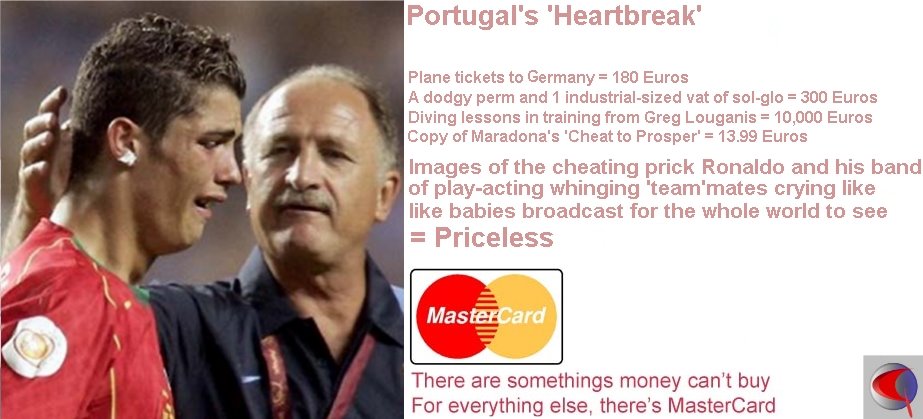

Bertie's Nitwit
In the Dáil this week, Taoiseach Bertie Ahern called Socialist Workers Party TD Joe Higgins a nitwit and suggested he should have stayed in Kerry.
If Bertie is right then this really is a case of a man leaving Kerry for the Dáil and simultaneously raising the average intelligence in both places.
Footnote: Published as a letter in the Irish Independent.
If Bertie is right then this really is a case of a man leaving Kerry for the Dáil and simultaneously raising the average intelligence in both places.
Footnote: Published as a letter in the Irish Independent.
Wednesday, July 05, 2006
Donegal Catch 22
The case currently in the High Court regarding the fate of 3 frozen embryos will make for a very interesting legal decision.
The couple who created the embryos were married at the time and, indeed, three other embryos which were implanted led to the birth of a child. However, the couple separated about a year later and now the ex-wife wants to use the embryos in an effort to have another child while the ex-husband is, understandably, resisting this.
The husband claims that the 3 frozen embryos were always only intended as a back-up to the first three which were actually implanted in case these did not produce a child. This seems entirely credible but the wife denies that it was ever specifically stated. It’s quite obvious she’s had a belated change of mind, quite possibly in order to punish her straying ex-husband who will be lumbered with maintenance responsibilities in the event of a successful birth.
Counsel for the ex-wife has argued that these embryos constitute “the unborn” and claimed protection for them under the constitution, which does indeed offer protection to the unborn child but crucially doesn’t define what constitutes an unborn child or when/where in the cycle from fertilisation to birth the entity achieves the status of “unborn child”.
At one stage in the proceedings it was being suggested that the 3 frozen embryos might be entitled to legal representation - presumably at least one senior and one junior counsel each. No wonder the legal profession is a veritable goldmine and the world is laughing at us.
While enormous sums of money are being consumed in legal fees, and abstract arguments are presented as to what actually constitutes an unborn child, this case will actually be decided on the two overarching but unwritten determinants in any case involving sex and/or reproduction in enlightened modern society:
(1) a woman’s inalienable right to change her mind, regardless of the consequences and
(2) a woman’s right to choose.
The latter is the ultimate and unanswerable argument when a woman wants to have her cake and eat it - and your cake too.
The couple who created the embryos were married at the time and, indeed, three other embryos which were implanted led to the birth of a child. However, the couple separated about a year later and now the ex-wife wants to use the embryos in an effort to have another child while the ex-husband is, understandably, resisting this.
The husband claims that the 3 frozen embryos were always only intended as a back-up to the first three which were actually implanted in case these did not produce a child. This seems entirely credible but the wife denies that it was ever specifically stated. It’s quite obvious she’s had a belated change of mind, quite possibly in order to punish her straying ex-husband who will be lumbered with maintenance responsibilities in the event of a successful birth.
Counsel for the ex-wife has argued that these embryos constitute “the unborn” and claimed protection for them under the constitution, which does indeed offer protection to the unborn child but crucially doesn’t define what constitutes an unborn child or when/where in the cycle from fertilisation to birth the entity achieves the status of “unborn child”.
At one stage in the proceedings it was being suggested that the 3 frozen embryos might be entitled to legal representation - presumably at least one senior and one junior counsel each. No wonder the legal profession is a veritable goldmine and the world is laughing at us.
While enormous sums of money are being consumed in legal fees, and abstract arguments are presented as to what actually constitutes an unborn child, this case will actually be decided on the two overarching but unwritten determinants in any case involving sex and/or reproduction in enlightened modern society:
(1) a woman’s inalienable right to change her mind, regardless of the consequences and
(2) a woman’s right to choose.
The latter is the ultimate and unanswerable argument when a woman wants to have her cake and eat it - and your cake too.
Tuesday, July 04, 2006
E-Voting - civil service managers asleep at the wheel
The findings of the Commission on Electronic Voting, published today, have been seized on by all sides in the debate as proof of the validity of their position. The opposition parties attack Government incompetence while representatives of the administration claim that upgrades to the software are a credible and affordable solution.
To my mind, the only thing this whole debacle conclusively demonstrates is the void in accountability of civil service management across a whole range of activities.
While the Government must take political responsibility for the e-voting debacle, who in the ranks of civil service managers is taking operational responsibility for the mess? No-one expects a Government minister to personally check the system software, but highly paid senior civil service managers would have been directly involved in the day-to-day management of the e-voting project and the necessary decisions which led to this outcome.
Yet the political furore has deflected any flak from the people with operational responsibility for delivering this system.
Someone was asleep at the wheel and civil service management heads should definitely be rolling. Instead they're lining up for phase 2 of benchmarking.
Footnote: Published as a letter in the Irish Independent & the Irish Examiner.
To my mind, the only thing this whole debacle conclusively demonstrates is the void in accountability of civil service management across a whole range of activities.
While the Government must take political responsibility for the e-voting debacle, who in the ranks of civil service managers is taking operational responsibility for the mess? No-one expects a Government minister to personally check the system software, but highly paid senior civil service managers would have been directly involved in the day-to-day management of the e-voting project and the necessary decisions which led to this outcome.
Yet the political furore has deflected any flak from the people with operational responsibility for delivering this system.
Someone was asleep at the wheel and civil service management heads should definitely be rolling. Instead they're lining up for phase 2 of benchmarking.
Footnote: Published as a letter in the Irish Independent & the Irish Examiner.
Monday, July 03, 2006
Don't bet, buy the bookies!
Saturday saw the overdue demise of my biggest bet on the World Cup - a pre-tournament €33 @ 3/1 on Brazil. I’d written it off for some time, having seen Brazil play in earlier rounds so the coup de grace delivered by France came as no great surprise.
The main talking point about Brazil seemed to be fitness of the greatly enlarged Ronaldo. If Brazil had played England we’d definitely have been listening to chants of “who ate all the pies?”. However, Ronaldo actually improved with each match as he got fitter/smaller while, for me, the real disappointment was Ronaldinho. He rarely displayed his brilliance, both skill and appetite for the game seemed largely invisible. He finally got the finger out after Henry scored for France but his efforts were usually smothered by an efficient French defence.
But wasn’t Zidane absolutely magnificent in the French midfield. He gave a footballing master class and his ball control was just magic. At one point he casually chipped the ball over the oncoming defender, ran around him and headed the ball to a suporting winger. Making it all look so simple. As he sent my bet up the swanee, I felt genuine regret that we were seeing this great footballer in his final tournament, a maximum of 2 more matches. I wonder could he have an Irish granny? He’d have several years left if he was in a green shirt.
The real tournament winners, of course, are the bookies. To date it must be an absolute bonanza for UK-based bookies as, of the four semi-finalists, probably only Italy would have featured in the top 5 in the pre-tournament betting. Brazil and Argentina getting knocked out would have given the bookies a huge pay-day but the real goldmine for them was the elimination of England which would have had huge patriotic backing in the UK.
On the betting exchange Betfair, over €24m in bets have been matched already on the World Cup winner book, which will probably reach €30m before the final is decided this week. This suggests that UK bookies have probably taken a significant multiple of €30m in bets to date - and most of those bets have already lost! The bookies satchels are bulging to overflowing.
Buy William Hill and/or Paddy Power shares now.
The main talking point about Brazil seemed to be fitness of the greatly enlarged Ronaldo. If Brazil had played England we’d definitely have been listening to chants of “who ate all the pies?”. However, Ronaldo actually improved with each match as he got fitter/smaller while, for me, the real disappointment was Ronaldinho. He rarely displayed his brilliance, both skill and appetite for the game seemed largely invisible. He finally got the finger out after Henry scored for France but his efforts were usually smothered by an efficient French defence.
But wasn’t Zidane absolutely magnificent in the French midfield. He gave a footballing master class and his ball control was just magic. At one point he casually chipped the ball over the oncoming defender, ran around him and headed the ball to a suporting winger. Making it all look so simple. As he sent my bet up the swanee, I felt genuine regret that we were seeing this great footballer in his final tournament, a maximum of 2 more matches. I wonder could he have an Irish granny? He’d have several years left if he was in a green shirt.
The real tournament winners, of course, are the bookies. To date it must be an absolute bonanza for UK-based bookies as, of the four semi-finalists, probably only Italy would have featured in the top 5 in the pre-tournament betting. Brazil and Argentina getting knocked out would have given the bookies a huge pay-day but the real goldmine for them was the elimination of England which would have had huge patriotic backing in the UK.
On the betting exchange Betfair, over €24m in bets have been matched already on the World Cup winner book, which will probably reach €30m before the final is decided this week. This suggests that UK bookies have probably taken a significant multiple of €30m in bets to date - and most of those bets have already lost! The bookies satchels are bulging to overflowing.
Buy William Hill and/or Paddy Power shares now.
Saturday, July 01, 2006
O'Malley Hare & Hound
Fiona O’Malley is the PD TD for Dun Laoghaire-Rathdown constituency who, hopefully, will lose her seat at the next election. She has the annoying habit of appearing on various radio programmes sounding off like a member of the opposition while she is, in fact, sitting on the government benches.
There’s no evidence that she ever inputs her top-of-head populist whinges at her own party meetings. If she does they’re clearly ignored as the government juggernaut trundles on regardless.
Smelling trouble ahead at next years general election, she’s now taken to writing to the Irish Times (see below). “Madam” is herself a former PD TD for the same constituency so I’m not holding my breath that she’ll publish my riposte which follows the O’Malley letter here.
Fiona O'Malley's letter published in Irish Times
Madam, - From Booterstown to the edge of Bray, there is rarely a household to which I call to during my constituency canvass where the issue of affordable housing is not raised.
While the Government has tried valiantly to deal with this issue, including writing commitments into the Partnership Agreement, it is obvious that something more radical is required.
James Pike (June 27th) points to work done by the All Party Oireachtas Committee on the Constitution in 2004 which recommends a return to the Kenny Report of the 1970s. The principal recommendation of that report was that land required by a local authority would be purchased at existing use value plus 25 per cent. Land costs contribute enormously to housing prices.
In my county of Dun Laoghaire Rathdown, we know all about it. The council has a very limited land bank. When land is sold, it attracts such high prices that very few houses, particularly for families, are available for less than €800,000. We are in danger of becoming a community where young families are being excluded by the cost of housing. This is unsustainable.
It is difficult to mount a credible defence of Government policy on the doorsteps when there is an obvious start that can be made. The Government should dust down the Kenny Report, prepare legislation and focus on an issue of real import to its citizens.
No wonder Fianna Fáil backbenchers are frustrated. Oireachtas committees are where backbenchers do good work. But unless the recommendations and work of these committees is taken seriously, frustrations will continue to fester and housing will stay beyond the means of many young people. - Yours, etc,
FIONA O'MALLEY TD, Dun Laoghaire, Co Dublin.
My response under the heading “O’Malley Hare & Hound”
Madam - Please do not allow your letters page to become a notice board for the extraordinary pleadings of desperate TDs in the run-up to the general election.
Fiona O’Malley, a government TD in this constituency, has an established record of trying to run with the hare while hunting with the hounds. Frankly, it’s completely lacking in credibility.
Yours etc
There’s no evidence that she ever inputs her top-of-head populist whinges at her own party meetings. If she does they’re clearly ignored as the government juggernaut trundles on regardless.
Smelling trouble ahead at next years general election, she’s now taken to writing to the Irish Times (see below). “Madam” is herself a former PD TD for the same constituency so I’m not holding my breath that she’ll publish my riposte which follows the O’Malley letter here.
Fiona O'Malley's letter published in Irish Times
Madam, - From Booterstown to the edge of Bray, there is rarely a household to which I call to during my constituency canvass where the issue of affordable housing is not raised.
While the Government has tried valiantly to deal with this issue, including writing commitments into the Partnership Agreement, it is obvious that something more radical is required.
James Pike (June 27th) points to work done by the All Party Oireachtas Committee on the Constitution in 2004 which recommends a return to the Kenny Report of the 1970s. The principal recommendation of that report was that land required by a local authority would be purchased at existing use value plus 25 per cent. Land costs contribute enormously to housing prices.
In my county of Dun Laoghaire Rathdown, we know all about it. The council has a very limited land bank. When land is sold, it attracts such high prices that very few houses, particularly for families, are available for less than €800,000. We are in danger of becoming a community where young families are being excluded by the cost of housing. This is unsustainable.
It is difficult to mount a credible defence of Government policy on the doorsteps when there is an obvious start that can be made. The Government should dust down the Kenny Report, prepare legislation and focus on an issue of real import to its citizens.
No wonder Fianna Fáil backbenchers are frustrated. Oireachtas committees are where backbenchers do good work. But unless the recommendations and work of these committees is taken seriously, frustrations will continue to fester and housing will stay beyond the means of many young people. - Yours, etc,
FIONA O'MALLEY TD, Dun Laoghaire, Co Dublin.
My response under the heading “O’Malley Hare & Hound”
Madam - Please do not allow your letters page to become a notice board for the extraordinary pleadings of desperate TDs in the run-up to the general election.
Fiona O’Malley, a government TD in this constituency, has an established record of trying to run with the hare while hunting with the hounds. Frankly, it’s completely lacking in credibility.
Yours etc
Wednesday, June 28, 2006
RTE - a gravy train we're all paying for.
RTE has just announced its top-10 earners in 2004.
1. Pat Kenny €899,000
2. Gerry Ryan €487,492
3. Marian Finucane €439,265
4. Joe Duffy €279,149
5. Miriam O'Callaghan €251,251
6. Ryan Tubridy €216,150
7. Derek Mooney €189,906
8. John Kelly €188,630
9. Sean O Rourke €177,463
10.George Hamilton €168,322
In addition, many of these will have earned substantial additional income from ancillary activities such as celebrity appearances, after dinner speaking, moderating seminars, involvement in independent TV productions etc..
Miriam O'Callaghan's RTE income is only exceeded by her Childrens Allowance.
We can safely assume that all these salaries will have increased by 10-20% in the intervening period. It’s a relief tome to know that the recent sizeable increase in RTE’s licence fee is not being wasted.
I've often complained when RTE's top "stars" disappear for 2-3 months every summer, accusing RTE of equating "public service broadcasting" with "teachers holidays".
However, when you see these salary lists you realise that it's probably a good thing. If they had to be paid for the extra months work the increase in the licence fee would be punitive.
Footnote: The section in italics published as a letter in the Irish Times & the Irish Independent.
1. Pat Kenny €899,000
2. Gerry Ryan €487,492
3. Marian Finucane €439,265
4. Joe Duffy €279,149
5. Miriam O'Callaghan €251,251
6. Ryan Tubridy €216,150
7. Derek Mooney €189,906
8. John Kelly €188,630
9. Sean O Rourke €177,463
10.George Hamilton €168,322
In addition, many of these will have earned substantial additional income from ancillary activities such as celebrity appearances, after dinner speaking, moderating seminars, involvement in independent TV productions etc..
Miriam O'Callaghan's RTE income is only exceeded by her Childrens Allowance.
We can safely assume that all these salaries will have increased by 10-20% in the intervening period. It’s a relief tome to know that the recent sizeable increase in RTE’s licence fee is not being wasted.
I've often complained when RTE's top "stars" disappear for 2-3 months every summer, accusing RTE of equating "public service broadcasting" with "teachers holidays".
However, when you see these salary lists you realise that it's probably a good thing. If they had to be paid for the extra months work the increase in the licence fee would be punitive.
Footnote: The section in italics published as a letter in the Irish Times & the Irish Independent.
Bertie the good shepherd
Bertie Ahern has comprehensively routed the back-bencher revolt and they have agreed to shelve the proposed Fianna Fail "1922 Committee".
To paraphrase Dennis Healey, Bertie seems to have found his back-benchers' rebellion to be equivalent to being savaged by a flock of dead sheep.
Whatever Bertie did or said in response to their public bleating, all we're hearing from them now now is the silence of the lambs.
Footnote: The section in italics published as a letter in the Irish Independent & the Irish Examiner. It also aired on "what it says in the papers" on RTE's Morning Ireland.
To paraphrase Dennis Healey, Bertie seems to have found his back-benchers' rebellion to be equivalent to being savaged by a flock of dead sheep.
Whatever Bertie did or said in response to their public bleating, all we're hearing from them now now is the silence of the lambs.
Footnote: The section in italics published as a letter in the Irish Independent & the Irish Examiner. It also aired on "what it says in the papers" on RTE's Morning Ireland.
Tuesday, June 27, 2006
Tax Dodgers in Paradise
The Revenue Commissioner’s analysis for 2002 shows that the top 400 earners in the state, who each earned in excess of €1m, paid an average tax rate of 24.4% and that 43 of these paid less than 5% in tax.
This will not come as any great surprise to ordinary PAYE taxpayers and the data merely confirms the need to cap the use of tax avoidance schemes as proposed in the last budget. However, the extended phasing of this change means that it will be several years before the target of a minimum 20% tax take from these high-rollers is actually achieved.
What is missing entirely from these Revenue Commissioner statistics is that group of Ireland’s wealthiest and most prominent businessmen who have declared themselves to be non-resident for tax purposes. Notwithstanding their non-resident status, these worthies appear regularly in the media as they conduct their business here, sitting on boards of directors, appearing before tribunals of inquiry, attending race meetings, social functions etc etc..
The inconvenience of being non-resident for tax purposes is not great as you can actually be in the country every day of the tax year, provided you remove yourself across our border at midnight on 50% of those days. You don’t even have to stay away for the night, you can slip back after midnight to sleep in your own bed. In the absence of electronic tagging and passport controls, who’s to say whether or not you even made the token effort of removing yourself temporarily from the jurisdiction?
Of tax evasion, tax avoidance and tax non-residency, only the former is deemed to be a crime but all three have the same effect. Each reduces the funds in the community chest which are required to pay for public services and essential infrastructure. This shortfall must either be made up by the compliant taxpayers or else public spending must be reduced, which invariably impacts most on those in greatest need - the elderly, the infirm, the handicapped and the poor. This is not a victimless activity, whether legal or not.
Irish citizenship carries rights but it also comes with obligations. Something along the lines of “from each according to his means, to each according to his needs” seems fair. Clearly those who engage in aggressive tax avoidance are within their rights but are actively seeking to avoid meeting their obligations. The same applies to those who effectively live and operate in Ireland but claim non-residency when it comes to their tax affairs.
The Revenue Commissioners regularly “name and shame” those caught evading tax, above a €12.7k threshold. They should also publish lists of those who benefit from tax avoidance schemes, quantifying the amount, subject to the same threshold. As for the tax non-residents, the law should be changed so that even if just one of your feet momentarily touches Irish soil, you are deemed to have been in Ireland for the day for tax purposes.
Such measures would, at least, be a start and should send a message both to the high fliers and to the ordinary tax payer.
Footnote: Published as a letter in the Irish Times & the Irish Examiner. I'm curiously waiting to see in the Irish Independent publishes, as Sir Anthony is one of our most prominent tax "exiles".
This will not come as any great surprise to ordinary PAYE taxpayers and the data merely confirms the need to cap the use of tax avoidance schemes as proposed in the last budget. However, the extended phasing of this change means that it will be several years before the target of a minimum 20% tax take from these high-rollers is actually achieved.
What is missing entirely from these Revenue Commissioner statistics is that group of Ireland’s wealthiest and most prominent businessmen who have declared themselves to be non-resident for tax purposes. Notwithstanding their non-resident status, these worthies appear regularly in the media as they conduct their business here, sitting on boards of directors, appearing before tribunals of inquiry, attending race meetings, social functions etc etc..
The inconvenience of being non-resident for tax purposes is not great as you can actually be in the country every day of the tax year, provided you remove yourself across our border at midnight on 50% of those days. You don’t even have to stay away for the night, you can slip back after midnight to sleep in your own bed. In the absence of electronic tagging and passport controls, who’s to say whether or not you even made the token effort of removing yourself temporarily from the jurisdiction?
Of tax evasion, tax avoidance and tax non-residency, only the former is deemed to be a crime but all three have the same effect. Each reduces the funds in the community chest which are required to pay for public services and essential infrastructure. This shortfall must either be made up by the compliant taxpayers or else public spending must be reduced, which invariably impacts most on those in greatest need - the elderly, the infirm, the handicapped and the poor. This is not a victimless activity, whether legal or not.
Irish citizenship carries rights but it also comes with obligations. Something along the lines of “from each according to his means, to each according to his needs” seems fair. Clearly those who engage in aggressive tax avoidance are within their rights but are actively seeking to avoid meeting their obligations. The same applies to those who effectively live and operate in Ireland but claim non-residency when it comes to their tax affairs.
The Revenue Commissioners regularly “name and shame” those caught evading tax, above a €12.7k threshold. They should also publish lists of those who benefit from tax avoidance schemes, quantifying the amount, subject to the same threshold. As for the tax non-residents, the law should be changed so that even if just one of your feet momentarily touches Irish soil, you are deemed to have been in Ireland for the day for tax purposes.
Such measures would, at least, be a start and should send a message both to the high fliers and to the ordinary tax payer.
Footnote: Published as a letter in the Irish Times & the Irish Examiner. I'm curiously waiting to see in the Irish Independent publishes, as Sir Anthony is one of our most prominent tax "exiles".
Thursday, June 22, 2006
McDowell's toys out of pram - again.
The Irish Times scoop about the attempted heave in the PDs (politically destitute?) was great news for those of us starved of political intrigue in recent months. We now have our very own Blair/Brown scenario, albeit in the smallest rather than the largest party.
Mind you, given his antics in recent months, the PDs would be mad to give the leadership to Michael McDowell before the next general election. Some of his outbursts have literally been small boy tantrums, which makes you regret the absence a political satire such as Spitting Images or Scrap Saturday - he’s such an ideal candidate for piss-taking.
If necessary and, of course, in the national interest, McDowell will probably leave the PDs and form his own party which might well be known as Mé Féin.
It strikes me that the name would probably make an appropriate sub-title for the PDs themselves - Progressive Democrats - the mé féin party.
Footnote: The penultimate paragraph of the above slag was published as a letter in the Irish Times, the Irish Independent & the Irish Examiner. It was also aired on Ryan Tubridy's RTE friday radio round-up of the week.
Mind you, given his antics in recent months, the PDs would be mad to give the leadership to Michael McDowell before the next general election. Some of his outbursts have literally been small boy tantrums, which makes you regret the absence a political satire such as Spitting Images or Scrap Saturday - he’s such an ideal candidate for piss-taking.
If necessary and, of course, in the national interest, McDowell will probably leave the PDs and form his own party which might well be known as Mé Féin.
It strikes me that the name would probably make an appropriate sub-title for the PDs themselves - Progressive Democrats - the mé féin party.
Footnote: The penultimate paragraph of the above slag was published as a letter in the Irish Times, the Irish Independent & the Irish Examiner. It was also aired on Ryan Tubridy's RTE friday radio round-up of the week.
Tuesday, June 20, 2006
The Haughey tunnel
Fianna Fail members of the city council are keen to name the soon to be opened port tunnel after their deceased hero, Charles J. Haughey.
If they succeed in doing so, it will undoubtedly be awarded an alternative nickname by dubliners.
I'd like to propose "The Northside Shaft" or just "The Shaft".
If they succeed in doing so, it will undoubtedly be awarded an alternative nickname by dubliners.
I'd like to propose "The Northside Shaft" or just "The Shaft".
The Boss follows in the footsteps of The Chief
Charles Haughey was not the first Taoiseach and leader of Fianna Fail to find creative and
innovative ways of supplementing his income. In that regard, The Boss was only following in the footsteps of The Chief.
When Eamon de Valera set up the Irish Press in 1931, it was largely funded by small shareholders in the USA. However, de Valera used a share structure that gave him complete control over the company, despite the fact that he only subscribed for $200 of the total share capital.
Over the subsequent years, The Irish Press became a cash cow for generations of the de Valera family. Despite the fact that the newspaper ceased production in 1995, de Valera’s grandson continues to extract substantial directors fees each year.
innovative ways of supplementing his income. In that regard, The Boss was only following in the footsteps of The Chief.
When Eamon de Valera set up the Irish Press in 1931, it was largely funded by small shareholders in the USA. However, de Valera used a share structure that gave him complete control over the company, despite the fact that he only subscribed for $200 of the total share capital.
Over the subsequent years, The Irish Press became a cash cow for generations of the de Valera family. Despite the fact that the newspaper ceased production in 1995, de Valera’s grandson continues to extract substantial directors fees each year.
Sunday, June 18, 2006
Ronan O'Gara - Alone he stands
"After several powerful scrums they created enough space for Luke McAlister to click past tackling turnstile Ronan O'Gara and seal the victory.
O'Gara's flaky defence had been a target in Hamilton as well, with McAlister admitting the All Blacks had been unable to isolate him."
The above is an extract from the New Zealand Herald coverage of Ireland's 27-17 defeat by the All Blacks on Saturday.
"Tackling Turnstile" is cruel but hard to dispute and it adds to existing criticism of O'Gara inability to make a break and thus at least tie-in some of the defence to deal with such a threat. Allied to similar limitations with Stringer, it really sets up the two centres as targets once the running option is chosen.
Sadly there are few obvious contenders for the out-half slot and it's unlikely a replacement can be found and groomed before the World Cup next year.
O'Gara's flaky defence had been a target in Hamilton as well, with McAlister admitting the All Blacks had been unable to isolate him."
The above is an extract from the New Zealand Herald coverage of Ireland's 27-17 defeat by the All Blacks on Saturday.
"Tackling Turnstile" is cruel but hard to dispute and it adds to existing criticism of O'Gara inability to make a break and thus at least tie-in some of the defence to deal with such a threat. Allied to similar limitations with Stringer, it really sets up the two centres as targets once the running option is chosen.
Sadly there are few obvious contenders for the out-half slot and it's unlikely a replacement can be found and groomed before the World Cup next year.
Vincent Browne re-invents GUBU!
The Pauline conversion of Vincent Browne to the cause of Charles Haughey has been one of the more intriguing side-shows in recent weeks.
Village magazine recently published an interview with the former secretary to Mr Haughey who revealed that, apparently, the then Taoiseach had no prior knowledge about Sean Doherty’s phone-tapping activities. Vincent Browne subsequently had her as a guest on his radio programme, where he conducted a lawyerly cross-examination of both the lady and his other panellists in an effort to demonstrate that Mr Haughey had been wrongly forced from office.
Incidentally, Vincent’s approach that night could not have contrasted more starkly with his most unlawyerly performance a couple of weeks earlier when, seeming to lose his temper, he hotly declared that Brother David Gibson should simply “shut up”, rather than seek to question the volume of accusations being levelled against members of the Christian Brothers.
The Browne thesis appears to be that if Mr Haughey was forced to resign on a false premise then we, the court of public opinion, should be required to ignore all the subsequent evidence against him which emerged in the various tribunals of inquiry and the fact that he perjured himself there.
This lawyerly logic may make sense to Vincent Browne but it doesn’t cut much ice with me. I don’t know what impact Vincent’s support may be having on the opinions of the “undecided”, but I suspect it’s placing a serious question mark over the good judgement of the advocate.
Footnote: Published as a letter in the Irish Independent and in Vincent Browne's Village Magazine.
Village magazine recently published an interview with the former secretary to Mr Haughey who revealed that, apparently, the then Taoiseach had no prior knowledge about Sean Doherty’s phone-tapping activities. Vincent Browne subsequently had her as a guest on his radio programme, where he conducted a lawyerly cross-examination of both the lady and his other panellists in an effort to demonstrate that Mr Haughey had been wrongly forced from office.
Incidentally, Vincent’s approach that night could not have contrasted more starkly with his most unlawyerly performance a couple of weeks earlier when, seeming to lose his temper, he hotly declared that Brother David Gibson should simply “shut up”, rather than seek to question the volume of accusations being levelled against members of the Christian Brothers.
The Browne thesis appears to be that if Mr Haughey was forced to resign on a false premise then we, the court of public opinion, should be required to ignore all the subsequent evidence against him which emerged in the various tribunals of inquiry and the fact that he perjured himself there.
This lawyerly logic may make sense to Vincent Browne but it doesn’t cut much ice with me. I don’t know what impact Vincent’s support may be having on the opinions of the “undecided”, but I suspect it’s placing a serious question mark over the good judgement of the advocate.
Footnote: Published as a letter in the Irish Independent and in Vincent Browne's Village Magazine.
Friday, June 16, 2006
Protocol gone mad
The state funeral for Charles J Haughey has been explained on the grounds of protocol, which grants the right to such a ceremony to all ex-Taoisigh.
This presumably would an extract from the same protocol manual which sent then Taoiseach de Valera to the German embassy in 1945 to extend condolences, on behalf of the Irish people, on the death of Adolf Hitler.
For all his faults there is clearly no equivalence between Haughey and the nazi monster, but it does just illustrate that protocol can be a complete ass.
This presumably would an extract from the same protocol manual which sent then Taoiseach de Valera to the German embassy in 1945 to extend condolences, on behalf of the Irish people, on the death of Adolf Hitler.
For all his faults there is clearly no equivalence between Haughey and the nazi monster, but it does just illustrate that protocol can be a complete ass.
The missing comma
The Bailey brothers of Bovale Developments have made a tax settlement of €25m, believed to be the largest, so far, in the history of the state.
When publishing their regular list of settlements extracted from tax defaulters, the Revenue Commissioners should at least consider producing the list under the banner headline: “They have done the state some service”. Of course, in time that might be abbreviated to “They have done the state”.
There is an ongoing debate about what Charlie Haughey actually meant to say in his valedictory address to the Dail. Those who have seen his script say that there was actually a comma inserted after the word “State”, which would make much better sense of the actual quotation in the context of Haughey’s career and subsequent revelations at the various tribunals.
When publishing their regular list of settlements extracted from tax defaulters, the Revenue Commissioners should at least consider producing the list under the banner headline: “They have done the state some service”. Of course, in time that might be abbreviated to “They have done the state”.
There is an ongoing debate about what Charlie Haughey actually meant to say in his valedictory address to the Dail. Those who have seen his script say that there was actually a comma inserted after the word “State”, which would make much better sense of the actual quotation in the context of Haughey’s career and subsequent revelations at the various tribunals.
Wednesday, June 14, 2006
Time gentlemen, please.
The Irish Times regularly advertises “reader offers” and today they offer us an outdoor clock which digitally displays time, date and temperature.
The ad makes the following claim for the device: “This amazing clock is accurate to less than a second in a million years”, which prompts a couple of questions:
(1) How have the manufacturers validated this claim?
(2) How would I go about claiming a refund in, say, 500,000 years should the claim prove to be invalid?
I've directed the query to "Madam".
The ad makes the following claim for the device: “This amazing clock is accurate to less than a second in a million years”, which prompts a couple of questions:
(1) How have the manufacturers validated this claim?
(2) How would I go about claiming a refund in, say, 500,000 years should the claim prove to be invalid?
I've directed the query to "Madam".
Haughey's Medici Complex
It is now widely recognised that Charles Haughey suffered from chronic Medici Complex.
Having attained the highest public office and greatly enriched himself and his family through its misuse, he then turned his considerable attention to leaving his mark indelibly on posterity.
Although a great admirer of Napoleon, a man of similar physical stature and humble background, Haughey immediately realised that a country of Ireland’s size would never be a major military power. He also recogised that the age of major expansion of national territory through military means was probably over, at least for his generation.
A classic poser, Haughey had also recognised that, both within and without Ireland, writing and other cultural activities are Ireland’s USP (unique selling proposition). A keen fan of Florentine political philosopher Niccolo Machiavelli’s (1469-1527) “The Prince”, which had long been his operating manual for domestic politics, Haughey began to model himself on Cosimo de Medici (1389-1464), the founder of Florence’s Medici dynasty which was a major influence on Machiavelli’s philosophical and political thinking.
Indeed, Haughey may well have been influenced by the contemporary portrait of Cosimo de Medici by Jacopo Pontormo (above). You can see that the likeness is striking. As with all these medieval princes, Haughey believed the first duty of the state was to provide him with financial prosperity and personal ennoblement. The assets of the state were the perosnal assets of the prince, to be used as he saw fit. Having achieved great wealth and the highest political office in the land, CJH then set about, Maslow-style, creating his place in history.
The implementation of Haughey’s strategy to create a long-term historical legacy involved surrounding himself with pompous opinionated pontificators, such as minor poet Anthony Cronin, peppering his speeches with scripted cultural references and quotations, adopting a world-weary aloof demeanour and, most importantly, dispensing largesse to the artistic community, all funded at public rather than his own expense. And, of course, having a cabinet of gombeen gobdaws ensured that he was always a major contrast-gainer in that company.
Thus Aosdana was born, as was the Artist’s Tax Exemption which, in addition to being of benefit to struggling domestic artists, attracted such down-at-heel artists as Freddie Forsyth and Def Leppard to our shores - temporarily at least, until the major portion of royalties had been paid.
Other public monies went on a variety of vanity projects, including Dingle Harbour and Government Buildings. The former ensured him a welcome in the Kingdom even after his public disgrace while the latter was reputedly inspired by a visit to President Mitterand at the Elysee Palace and has become known to dubliners as The Chas Mahal.
It is difficult to convey in words how this complex manifested itself, but it was brilliantly illustrated by RTE's satirical radio programme Scrap Saturday. This regularly featured a sketch in which Haughey is reminiscing about his roots - he's always a descendant of mythic celtic warriors, greek philosophers or roman generals and emperors, why he's even related to the Japanese royal family through Hirohito Haughey.
RTE should replay those extracts as a tribute to the man and also as a wake-up call for all those misty-eyed eejits out there who think you should never speak ill of the dead!
Tuesday, June 13, 2006
Death of Charles Haughey
The death of Charles Haughey provides further proof of our almost endless capacity for hypocrisy as politicians and commentators who vilified Mr Haughey in life now queue up to find positive things to say about him in death.
The justification offered is often to do with the feelings of the family at this difficult time for them. However, we should not forget it was Mr Haughey who betrayed his wife with a very public affair over a period of three decades and that his family were, and continue to be, material financial beneficiaries of his extraordinary funding arrangements.
The anecdotes now filling the media tend to portray Mr Haughey as a loveable rogue, rather than the man who must bear most responsibility for the corruption that became almost endemic in the biggest political party in the state and, as revealed in the various tribunals, spread its
tentacles into many areas of public life and administration.
Whatever credit he may be due for some of his contributions to public life, his death should not now be a coat of whitewash for his misdeeds.
Footnote: Published as a letter in the Irish Times, the Irish Independent & the Irish Examiner.
The justification offered is often to do with the feelings of the family at this difficult time for them. However, we should not forget it was Mr Haughey who betrayed his wife with a very public affair over a period of three decades and that his family were, and continue to be, material financial beneficiaries of his extraordinary funding arrangements.
The anecdotes now filling the media tend to portray Mr Haughey as a loveable rogue, rather than the man who must bear most responsibility for the corruption that became almost endemic in the biggest political party in the state and, as revealed in the various tribunals, spread its
tentacles into many areas of public life and administration.
Whatever credit he may be due for some of his contributions to public life, his death should not now be a coat of whitewash for his misdeeds.
Footnote: Published as a letter in the Irish Times, the Irish Independent & the Irish Examiner.
Gone but not forgiven - Charlie Haughey
In the Haughey biography you'll find that, as in the dictionary, Prostate Cancer came between a Jail Sentence and a State Funeral.
A great pity that he didn't follow Liam Lawlor's example and spend some of his later years in the Joy.
A great pity that he didn't follow Liam Lawlor's example and spend some of his later years in the Joy.
That Maths Paper
A great media kefuffle about the Leaving Cert Honours Maths paper which, apparently, was over-demanding on the logical skills of the students. Questions didn't come up in the sequence or format that teachers or students had expected, based on previous years exams.
Could this have been a secret Govt plot to reduce the number of women gaining maximum Leaving Cert points, filling all the medical places in college and then, when qualified, being unwilling to work the hours the public needs? It's well known that married women doctors want 9-5 jobs and are often unwilling to work as GPs or as hospital doctors outside "normal office hours".
Maths is a logical science, and it makes sense to test the logical ability of the candidate rather than their ability to simply memorise large numbers of formulae and solutions.
I suspect that girls are better at Rote Learning because, God knows, when they become women it's very hard to get a logical answer or response from them.
Could this have been a secret Govt plot to reduce the number of women gaining maximum Leaving Cert points, filling all the medical places in college and then, when qualified, being unwilling to work the hours the public needs? It's well known that married women doctors want 9-5 jobs and are often unwilling to work as GPs or as hospital doctors outside "normal office hours".
Maths is a logical science, and it makes sense to test the logical ability of the candidate rather than their ability to simply memorise large numbers of formulae and solutions.
I suspect that girls are better at Rote Learning because, God knows, when they become women it's very hard to get a logical answer or response from them.
Wednesday, June 07, 2006
Learning to Reed & Rite
Today’s Irish Times carries a report on educational reform which opens with the sentence “Taoiseach Bertie Ahern has backed reform of the Leaving Cert, which would see less stress on rote learning and more on practical work”.
From some recent written evidence, with multiple incorrect spellings, it would seem that he himself has already instituted a change in “rite” learning.
Of course this may all be a simple misunderstanding of the Taoiseach's position. It may well be that he thinks “rote” is the past tense of “rite”.
From some recent written evidence, with multiple incorrect spellings, it would seem that he himself has already instituted a change in “rite” learning.
Of course this may all be a simple misunderstanding of the Taoiseach's position. It may well be that he thinks “rote” is the past tense of “rite”.
What's the point of the new Garda Traffic Corps?
Driving from Rosslare to Dublin yesterday, it took one hour to get through Gorey at lunchtime, a distance of about one mile. This delay wasn’t the result of road works or an accident, it was just a normal day’s experience in this particular town. Needless to say, I didn’t see a single garda in that hour.
It would be unsurprising if many motorists subsequently exceeded the speed limit in an effort to make up for this lost time. It’s certainly unlikely that it helped improve tempers or road manners.
Does the much heralded Garda Traffic Corps have any responsibility for ensuring that traffic flows as smoothly as possible or are they just there to catch us when we break the law? Why is it that you almost never see a garda on point duty, unless there’s some politician or visiting dignitary being whisked through, while the rest of us are delayed in the national interest.
We have been reminded in recent months that Gardai spend two years learning their trade in Templemore. Is it that they now consider themselves over-qualified for point duty, or do they need to spend even longer in training school? It could be that organised crime is very active in Gorey, consuming all available garda resources, but I doubt it.
Hopefully the reservists will help to sort out the problem.
Footnote: Published as a letter in the irish Times, but with some unfortunate editing grammatical cock-ups. Also in the Irish Independent & the Irish Examiner.
Which prompted the following note to the IT editor:
Madam,
I have a query regarding my letter published on 8th June under the above heading.
Does you edit all the letters yourself or does you delegate the task?
Yours etc.
It would be unsurprising if many motorists subsequently exceeded the speed limit in an effort to make up for this lost time. It’s certainly unlikely that it helped improve tempers or road manners.
Does the much heralded Garda Traffic Corps have any responsibility for ensuring that traffic flows as smoothly as possible or are they just there to catch us when we break the law? Why is it that you almost never see a garda on point duty, unless there’s some politician or visiting dignitary being whisked through, while the rest of us are delayed in the national interest.
We have been reminded in recent months that Gardai spend two years learning their trade in Templemore. Is it that they now consider themselves over-qualified for point duty, or do they need to spend even longer in training school? It could be that organised crime is very active in Gorey, consuming all available garda resources, but I doubt it.
Hopefully the reservists will help to sort out the problem.
Footnote: Published as a letter in the irish Times, but with some unfortunate editing grammatical cock-ups. Also in the Irish Independent & the Irish Examiner.
Which prompted the following note to the IT editor:
Madam,
I have a query regarding my letter published on 8th June under the above heading.
Does you edit all the letters yourself or does you delegate the task?
Yours etc.
Thursday, June 01, 2006
Turning up the heat on Michael Moore?
Published today in The Guardian, this article probably tell it like it is in making a Michael Moore mockumentary.
Fahrenheit £40m: armless soldier sues Moore for using his image in anti-war film
· Veteran says film wrongly showed him as war critic
· Lawyer claims footage was used without permission
Dan Glaister in Los Angeles
Friday June 2, 2006
The Guardian
It's a powerful moment in Michael Moore's anti-war film Fahrenheit 9/11. A young American soldier who lost his arms in a helicopter explosion is describing his injuries. The soldier, Sergeant Peter Damon, says he feels like he is being "crushed in a vice". Painkillers, he continues, "take a lot of the edge off of it".
The scene follows a clip showing the Democratic congressman Jim McDermott criticising the Bush administration's conduct of the war in Iraq. "You know, they say they're not leaving any veterans behind, but they're leaving all kinds of veterans behind," the politician says.
It bolsters the anti-war sentiments of the film, suggesting that Sgt Damon and others were abandoned by America's political leaders after sustaining horrific injuries in pursuit of a conflict about which many developed doubts.
But now Sgt Damon is suing the man who he says used footage of him without his permission and distorted his words. He never met Moore, or anyone from his production company, says the former soldier, who is claiming $75m (£40m) in damages for "loss of reputation, emotional distress, embarrassment, and personal humiliation".
Sgt Damon's wife is seeking an additional $10m in damages because of the mental distress caused to her husband.
The interview which appears in Moore's film was conducted by a prime-time news programme, NBC's Dateline, for a report about a new painkiller. The NBC report ends with the words: "These men, with catastrophic wounds are ... completely behind the war effort."
In his lawsuit, Sgt Damon alleges Moore misrepresented his words to make it appear he was critical of the war. He "agrees with and supports the president and the United States' war effort, and he was not left behind", he states.
"They took the clip because it was a gut-wrenching scene," Sgt Damon told the New York Post. "They sandwiched it in. [Moore] was using me as ammunition ... I was complaining about the pain I would've been having.
"I just want everybody to know what kind of a guy Michael Moore is, and what kind of film this is," he said.
Moore's film, which won the Palme d'Or at Cannes in 2004, became the biggest-grossing documentary in history, taking $222.5m at the box office worldwide.
Sgt Damon's lawyer, Dennis Lynch, said he had been struck by the soldier's story when he met him at a St Patrick's Day parade. "You see a man that has lost both his arms, is obviously disabled, a man that supports his country and the policy in Iraq, and you hear about his name and image being used in a manner that is contrary to everything he believes in. There's a lot of harm been done. Michael Moore took my client's good name and reputation and defamed him using WMD - weapons of mass defamation."
Mr Lynch said he had tried for more than a year to settle the complaint, but Moore and his lawyers rejected any negotiation. "We didn't just rush to court with this," he said.
Sgt Damon, 33, knew nothing about his appearance in Fahrenheit 9/11 until a friend of his in hospital greeted him one day with the words: "Hey, movie star".
The soldier did make a subsequent appearance on camera, but it was in the anti-Michael Moore film Fahrenhype 9/11. Addressing Moore through the camera, he says: "You know you've lied in making this movie. You know you lied in my case, you know you lied in a whole lot of other cases."
"I was ecstatic when I saw that he was suing Michael Moore," said the Farenhype 9/11 director, Alan Peterson.
Neither NBC nor Moore obtained a release form from Sgt Damon giving permission for them to use his image. NBC is named in Sgt Damon's lawsuit, as are the producers of Fahrenheit 9/11, Miramax and LionsGate films and companies involved in the distribution of the film. None of the companies would comment on the lawsuit. Moore did not return messages requesting comment.
According to Peterson, Sgt Damon's experience is typical of the subjects in Moore's films. "We went through Michael Moore's film and looked at the people he interviewed and asked them if they felt they had been fairly treated," he said. "More often than not they didn't know they had been interviewed for the film."
Peterson said others might well come forward with claims against Moore. "It wouldn't surprise me if this rippled through Michael Moore's other films," he said, "because his modus operandi hasn't changed. Michael Moore and Miramax made a ton of money off these people. It will be interesting to see how the courts view that.
"I hope it sends a message to film-makers that we have to be careful. The idea that there is objectivity in film-making is ridiculous.
"I hope this helps people understand that when you watch something you have to be aware of where it's coming from."
Fahrenheit £40m: armless soldier sues Moore for using his image in anti-war film
· Veteran says film wrongly showed him as war critic
· Lawyer claims footage was used without permission
Dan Glaister in Los Angeles
Friday June 2, 2006
The Guardian
It's a powerful moment in Michael Moore's anti-war film Fahrenheit 9/11. A young American soldier who lost his arms in a helicopter explosion is describing his injuries. The soldier, Sergeant Peter Damon, says he feels like he is being "crushed in a vice". Painkillers, he continues, "take a lot of the edge off of it".
The scene follows a clip showing the Democratic congressman Jim McDermott criticising the Bush administration's conduct of the war in Iraq. "You know, they say they're not leaving any veterans behind, but they're leaving all kinds of veterans behind," the politician says.
It bolsters the anti-war sentiments of the film, suggesting that Sgt Damon and others were abandoned by America's political leaders after sustaining horrific injuries in pursuit of a conflict about which many developed doubts.
But now Sgt Damon is suing the man who he says used footage of him without his permission and distorted his words. He never met Moore, or anyone from his production company, says the former soldier, who is claiming $75m (£40m) in damages for "loss of reputation, emotional distress, embarrassment, and personal humiliation".
Sgt Damon's wife is seeking an additional $10m in damages because of the mental distress caused to her husband.
The interview which appears in Moore's film was conducted by a prime-time news programme, NBC's Dateline, for a report about a new painkiller. The NBC report ends with the words: "These men, with catastrophic wounds are ... completely behind the war effort."
In his lawsuit, Sgt Damon alleges Moore misrepresented his words to make it appear he was critical of the war. He "agrees with and supports the president and the United States' war effort, and he was not left behind", he states.
"They took the clip because it was a gut-wrenching scene," Sgt Damon told the New York Post. "They sandwiched it in. [Moore] was using me as ammunition ... I was complaining about the pain I would've been having.
"I just want everybody to know what kind of a guy Michael Moore is, and what kind of film this is," he said.
Moore's film, which won the Palme d'Or at Cannes in 2004, became the biggest-grossing documentary in history, taking $222.5m at the box office worldwide.
Sgt Damon's lawyer, Dennis Lynch, said he had been struck by the soldier's story when he met him at a St Patrick's Day parade. "You see a man that has lost both his arms, is obviously disabled, a man that supports his country and the policy in Iraq, and you hear about his name and image being used in a manner that is contrary to everything he believes in. There's a lot of harm been done. Michael Moore took my client's good name and reputation and defamed him using WMD - weapons of mass defamation."
Mr Lynch said he had tried for more than a year to settle the complaint, but Moore and his lawyers rejected any negotiation. "We didn't just rush to court with this," he said.
Sgt Damon, 33, knew nothing about his appearance in Fahrenheit 9/11 until a friend of his in hospital greeted him one day with the words: "Hey, movie star".
The soldier did make a subsequent appearance on camera, but it was in the anti-Michael Moore film Fahrenhype 9/11. Addressing Moore through the camera, he says: "You know you've lied in making this movie. You know you lied in my case, you know you lied in a whole lot of other cases."
"I was ecstatic when I saw that he was suing Michael Moore," said the Farenhype 9/11 director, Alan Peterson.
Neither NBC nor Moore obtained a release form from Sgt Damon giving permission for them to use his image. NBC is named in Sgt Damon's lawsuit, as are the producers of Fahrenheit 9/11, Miramax and LionsGate films and companies involved in the distribution of the film. None of the companies would comment on the lawsuit. Moore did not return messages requesting comment.
According to Peterson, Sgt Damon's experience is typical of the subjects in Moore's films. "We went through Michael Moore's film and looked at the people he interviewed and asked them if they felt they had been fairly treated," he said. "More often than not they didn't know they had been interviewed for the film."
Peterson said others might well come forward with claims against Moore. "It wouldn't surprise me if this rippled through Michael Moore's other films," he said, "because his modus operandi hasn't changed. Michael Moore and Miramax made a ton of money off these people. It will be interesting to see how the courts view that.
"I hope it sends a message to film-makers that we have to be careful. The idea that there is objectivity in film-making is ridiculous.
"I hope this helps people understand that when you watch something you have to be aware of where it's coming from."
Re-trying Derry O'Rourke?
Derry O’Rourke, the former national swimming coach, was convicted 8 years ago of raping 12 under-age girls who were in his charge as a swimming coach.
A caller to RTE’s Liveline today said she had been sexually abused by Derry O'Rourke. She said that he was prosecuted on sample charges for the offences against her, but that he had, in fact, also abused her on many other occasions.
In that situation, could O'Rourke now be charged with new offences for other specific assaults on this woman, other than those which were the sample charges in the original case?
If this is possible, could it also be a mechanism to re-try other offenders who are now being released? The use of such sample charges rather than an exhaustive list of every criminal act is quite a common procedure.
A caller to RTE’s Liveline today said she had been sexually abused by Derry O'Rourke. She said that he was prosecuted on sample charges for the offences against her, but that he had, in fact, also abused her on many other occasions.
In that situation, could O'Rourke now be charged with new offences for other specific assaults on this woman, other than those which were the sample charges in the original case?
If this is possible, could it also be a mechanism to re-try other offenders who are now being released? The use of such sample charges rather than an exhaustive list of every criminal act is quite a common procedure.
Subscribe to:
Posts (Atom)